

Why Grooming Detection Follows Path Changes
One message can look harmless. A message pattern can show risk fast.
I’d sum the article up like this: if you only review single comments or DMs, you miss how grooming often works. It usually starts small, then shifts step by step into age checks, secrecy, gifts, off-platform moves, and pressure. That’s why I’d track the path of a conversation, not just isolated words.
Here’s the core idea in plain English:
- Grooming often builds over days or weeks
- Early messages may look normal on their own
- Risk shows up when the thread changes direction
- DMs matter most because much of this starts or moves there
- Alerts should score the sequence, not just one message
- Review teams need plain-English reasons and a clean evidence record
A few stats make the point clear:
- 80% of predatory cases begin in DMs and public comments
- 30% of sextortion victims face demands within 24 hours
- Less than 10% of grooming incidents reach authorities
- Sequence-aware systems can flag risk in under 200 milliseconds and route it in under 4 seconds
What I take from this is simple: the risk is not just in what someone says, but in how the conversation moves. That shift is what path-based detection is built to catch.
What a behavioral path and a path deviation are
Behavioral paths show how conversations normally progress
A behavioral path is the pattern of how a conversation changes over time, not the exact wording people use. In a direct-message thread, the main signal is the shift from one message to the next.
Most paths follow a familiar arc: casual contact, then fact-finding, then incentives, then a push toward private channels, and then escalation. That sequence - not any one message by itself - is what defines the path.
Path deviations signal a change in risk level
A path deviation is a meaningful turn away from that usual progression. It points to a move toward secrecy, intimacy, or more intrusive requests. This is the moment when a chat about school or gaming suddenly pivots to private photos, daily schedules, or a request to switch to another app.
A common deviation is moving the conversation to another app. That lowers visibility and can point to escalation.
Why small changes matter more than single keywords
Grooming often avoids explicit language at the start, so single messages can seem harmless on their own. The risk shows up when those harmless-looking messages build into a pattern. An age-related question might mean very little by itself. But if it comes after unsolicited compliments and right before a gift offer, it starts to fit a identifiable grooming patterns. When that pattern changes, the system can send an alert based on the new risk level.
sbb-itb-47c24b3
How alerts fire when a conversation changes course
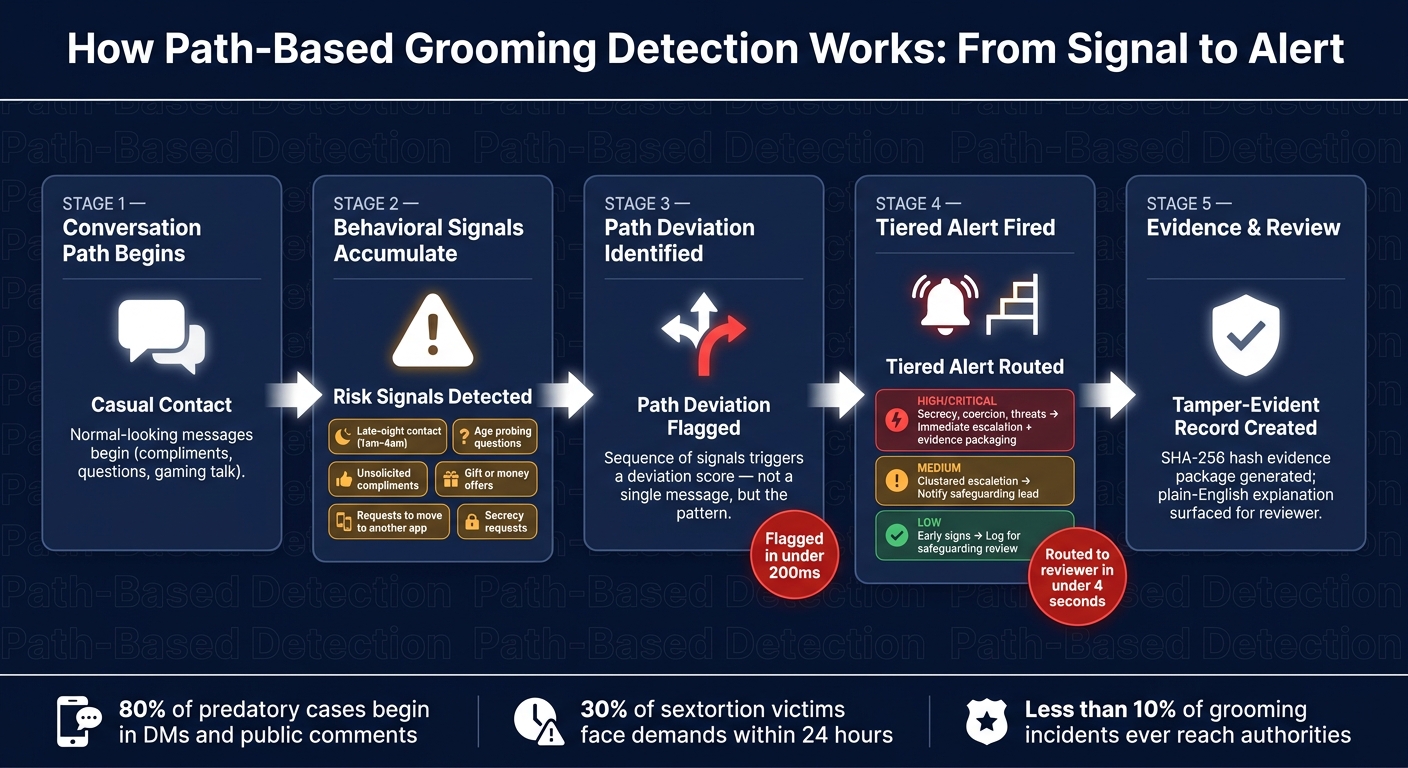
How Path-Based Grooming Detection Works: From Signal to Alert
Once a conversation starts to drift off its usual path, the system turns that shift into an alert.
Signals that commonly raise risk scores
One message, by itself, usually doesn't decide the outcome. Instead, risk builds as each new message changes the real-time risk scoring in real time.
Signals that often push risk higher include time-based signals, like late-night contact, personal probing, such as unsolicited compliments paired with age-related questions, secrecy requests, incentives like gifts or money, and attempts to move the conversation to another channel. When several of these show up in sequence instead of as one-off moments, the system marks that as a meaningful change in where the conversation is heading.
Low-, medium-, and high-severity alerts serve different teams
Not every alert calls for the same kind of response. Tiered alerting helps route the signal to the right reviewer based on urgency. Low-severity alerts cover early signs. Medium-severity alerts point to clustered escalation. High-severity alerts trigger immediate escalation and evidence packaging.
Each alert also needs to show which signals raised the score. That only works if the system explains those signals in plain English, so a reviewer can see what happened without having to decode jargon.
Path deviations and alert responses
Here are some common path deviations and the usual response:
| Path Deviation | What It Looks Like in Messages | Typical Risk Increase | Response |
|---|---|---|---|
| Age probing | "How old are you?" / "Do you go to [School Name]?" | Low to Medium | Log for safeguarding review; monitor for frequency |
| Late-night contact | Repeated messages between 1 a.m. and 4 a.m. | Low to Medium | Early-stage notification for safeguarding review |
| Channel migration | "Let's talk on WhatsApp/iMessage instead." | Medium to High | Immediate alert to parent or safeguarding lead |
| Secrecy request | "Don't tell your parents about our chat." | High | Critical alert; initiate evidence packaging |
| Incentivization | "I'll send you a $50 gift card if you send a photo." | High | Flag for safeguarding review; escalate for review |
| Coercion or threats | "Pay me or I'll send these photos to your friends." | Critical | Immediate escalation to authorities/law enforcement |
Those alerts only help if the system reads the full DM thread in context.
Why context in direct messages determines detection accuracy
Conversation history changes the meaning of each message
A single message can mean one thing in one chat and something else entirely in another. A compliment, a joke, or a request to switch to another platform might look harmless on its own. But when you read it as part of the full thread, it can fit a familiar escalation pattern.
That’s why full-thread context matters so much. It gives each new message its actual meaning. Account context matters too. An unverified adult account contacting a minor is a major signal that should push the threat score higher. Pattern-based models use that thread-level context to turn scattered signals into a risk score.
Behavioral models make risk scores explainable
Pattern-based models look at how a conversation unfolds and score the intent behind it instead of just checking messages against a blocklist. So rather than flagging one message in isolation, the model looks at the pattern across the thread: sustained targeting, escalation, and coercion.
That shift matters. It helps teams see why a conversation was flagged, not just that it was flagged. The system can surface a plain-English explanation of which signals pushed the risk level up.
Research shows that 30% of sextortion victims face demands within 24 hours of initial contact [3]. In plain terms, if a system waits for obvious red flags, it will often miss the moment when action would have helped most.
Guardii uses this approach in practice. It analyzes behavioral patterns in real time inside direct messages and surfaces a live risk score with plain-English explanations of which signals raised it [2].
Privacy, auditability, and compliance matter as much as detection
Getting the model right is only part of the job. The next step is handling the data safely.
Institutions need least-necessary data access, tamper-evident evidence, and human review only for high-risk cases. When a case crosses that line, it should produce a tamper-evident evidence package, such as a SHA-256 hash, so teams can preserve chain of custody. That balance helps people act on risk without exposing more message content than they need to see.
Conclusion: Why path-based detection outperforms message-only review
Grooming tends to build step by step. Because of that, looking at one message at a time often misses the moment when ordinary contact turns into targeted abuse. The key signal isn't just what one message says. It's how the thread changes over time.
Path-based detection follows that progression. If a conversation starts drifting toward platform migration, secrecy, or more personal questions, the system can spot that change, flag the deviation, and increase the risk score. Once that pattern shows up, it can escalate the thread in real time.
That speed matters. Sextortion demands can arrive within 24 hours of first contact [3]. Sequence-aware systems can flag risk in under 200 milliseconds and send it to a reviewer in under 4 seconds [1]. Manual review often can't move that fast, which means the key window can close before anyone steps in.
Of course, speed alone isn't enough. Reviewers also need context they can use to justify action. For schools, law enforcement, clubs, and compliance teams, that means context plus a record they can stand behind. Plain-English alerts explain why a thread was flagged, and tamper-evident evidence supports review [1][2].
Less than 10% of grooming incidents ever reach authorities [1][2]. That's part of why path-based detection works so well: grooming often changes course before it becomes obvious in any single message.
FAQs
What is a path deviation?
A path deviation is a change in behavior that points to a move away from normal interaction and toward grooming or exploitation. That can look like shifting a conversation to a private channel, pulling for personal details, or a sudden jump in how often someone messages.
When you track those shifts in context, systems like Guardii can spot when a conversation starts moving down a predatory path and judge risk in real time.
How do alerts fire?
Alerts fire when the system spots suspicious, escalating grooming behavior in DMs over time, not just single keywords pulled out of context. It looks at the pattern, scores the likely intent and severity, and then triggers the right response.
That might mean a real-time parent alert. In higher-impact cases, it can route the case for human review, complete with evidence packaging and audit trails. The system handles the process on its own until a human decision is needed.
Why do DMs need full context?
DMs need the full conversation, not just a single line. Grooming and sextortion usually don’t depend on one obvious keyword. They build over time through patterns of behavior - like compliments, questions about age, attempts to move the chat to another app, requests for secrecy, and later, threats.
When you strip away the surrounding messages, alerts can miss how the situation is building. They may read the intent the wrong way or score the risk badly. Context makes it easier to judge both intent and escalation across the entire DM exchange, instead of trying to make sense of isolated fragments.