

10 Red Flag Grooming Behaviors Researchers Track
Most grooming does not start with an obvious sexual message. It starts with a pattern.
If I had to sum up the article in one line, it would be this: researchers look for repeated behavior that moves from trust, to secrecy, to control. A single compliment or gift may look harmless. But when I see personal probing, private-channel moves, secrecy requests, isolation, sexual testing, and then threats, that pattern points to danger.
Here’s the full list the article covers:
- Information extraction
- Excessive flattery
- Gifts or money tied to compliance
- Secrecy demands
- Private-channel migration
- Isolation from parents or friends
- Sexual testing and boundary pushing
- Emotional manipulation and guilt
- Threats, blackmail, and sextortion
- Pattern-based detection across the full message trail
A few numbers stand out:
- Participants in one study estimated only a 30% chance of abuse when grooming behaviors were shown without the outcome.
- “Don’t tell anyone” was about 46.46 times more likely to appear in abuse cases than in healthy adult-child interaction.
- Financial sextortion reports reached 23,593 cases in the first half of 2025.
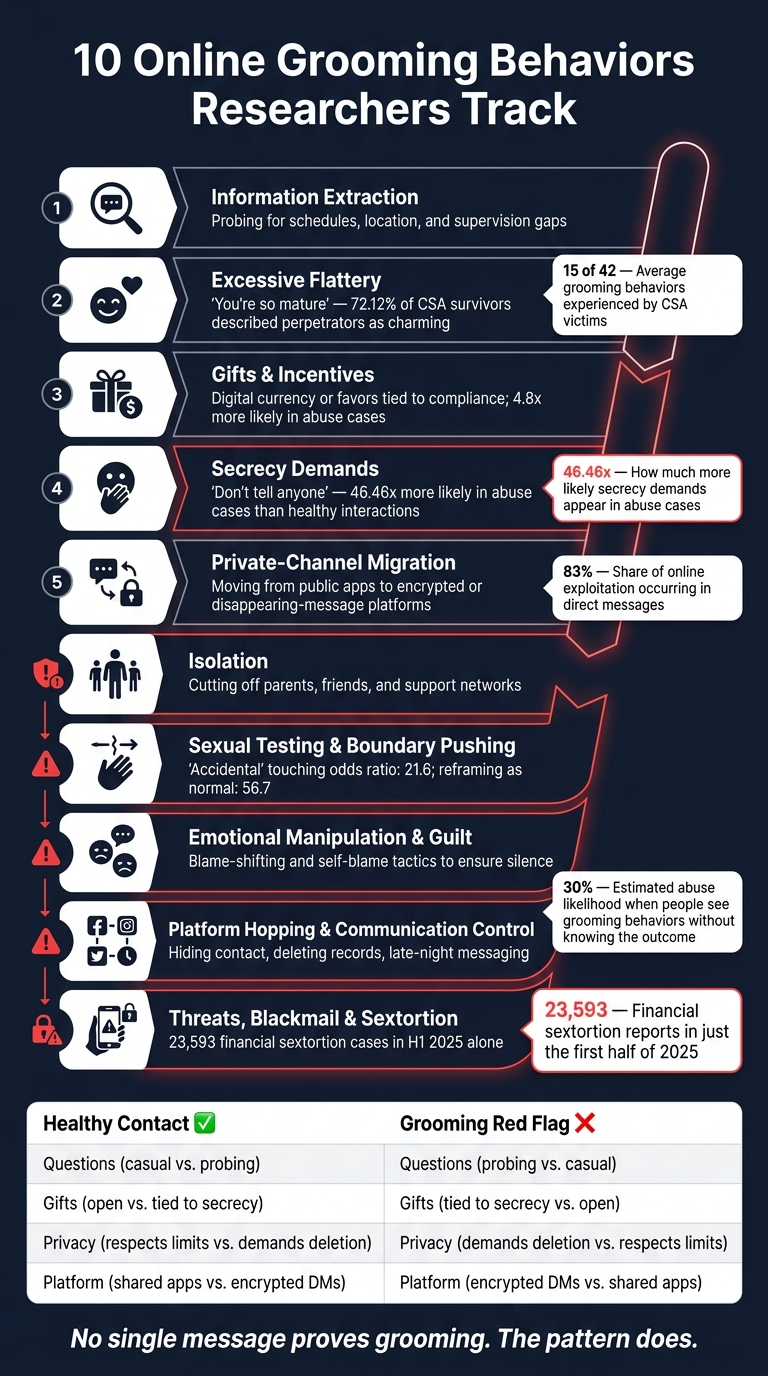
10 Online Grooming Behaviors: How Predators Escalate From Trust to Coercion
5 Warning Signs of Cyber Grooming
sbb-itb-47c24b3
Quick Comparison
| Behavior | Healthy contact | Red flag pattern |
|---|---|---|
| Questions | Casual back-and-forth | Probing for schedule, location, supervision |
| Compliments | Occasional and age-appropriate | Repeated praise meant to build private loyalty |
| Gifts | Open and known to caregivers | Tied to secrecy, favors, or pressure |
| Privacy | Respects boundaries | “Delete this,” “don’t tell your parents” |
| Platform use | Stays in normal spaces | Pushes to DMs or disappearing chats |
| Boundaries | Accepts “no” | Tests limits, then escalates |
| Conflict | No coercion | Shame, threats, blackmail |
The key point: no single message proves grooming, but the direction of the conversation often does. Using AI-powered child safety tools can help parents identify these patterns before they escalate.
Why Researchers Track Behavior Patterns Instead of Single Messages
Why individual messages can look harmless on their own
A compliment, a gift, or an offer to help with homework can seem ordinary by itself. That’s part of what makes this hard. Researchers point out that grooming can look like normal care at first; the key difference is the repeat pattern and the intent behind it. Instead of judging one message in isolation, they look at what happens across many exchanges: repetition, escalation, and control.
The progression arcs researchers look for
Researchers often describe grooming as a progression that starts with trust-building and moves toward isolation and sexualization. Common stages include targeting, trust-building, secrecy, isolation, sexualization, and coercion [2][4].
That slow build is a big reason early warning signs get missed. In experimental studies, participants who read scenarios with grooming behaviors - without being told the outcome - estimated only a 30% likelihood of abuse [4]. In plain English, many of these early moves didn’t look alarming at first glance. Stages like victim selection and trust-building were often the hardest to spot.
That recurring pattern is what the 10 behaviors below break down.
How pattern-based detection systems can help
This is why detection tools focus on behavior patterns instead of single words. Early grooming often relies on friendly, everyday language that masks the intent, so keyword filters alone don’t do the job.
Guardii is one example of an AI platform that detects these patterns in private messages, including platform migration, information extraction, secrecy requests, incentive offers, and threat escalation. The next sections show how each pattern appears in practice.
1. Information Extraction and Personal Data Probing
One of the first things researchers watch for is the moment a chat stops feeling casual and starts turning into a profile. Information extraction often begins with harmless small talk, then shifts toward questions that reveal a child’s routine, location, and level of supervision.
It usually starts with everyday topics like hobbies, favorite games, or music. Then it gets more pointed: What school do you go to? What time do you get home? Do your parents work late? Bit by bit, each answer helps the offender build a clearer picture of the child’s routines and weak points. Researchers describe this as profiling vulnerabilities - using conversation to spot psychological soft spots like loneliness, low self-esteem, or limited parental supervision [2][5].
What makes this different from normal curiosity between peers is the intent behind it. Predatory probing tends to be one-sided and deceptive. The goal isn’t simple conversation. It’s to gather leverage while keeping parents out of the picture.
That personal detail often sets up the next move: requests for photos and other favors. A photo request may sound harmless at first - just a selfie - but that’s often part of the setup. It builds a pattern of compliance before the requests turn more private. In case reviews, researchers flag photo requests, along with questions about schedules and location, as some of the clearest warning signs [2].
In the first half of 2025, NCMEC logged more than 518,000 online enticement reports, which shows just how common this tactic is [6]. Once the offender has enough detail, the conversation often shifts toward secrecy and control.
2. Excessive Flattery and Idealization
After asking for personal details, offenders often shift to flattery to pull a child in. It may start as praise, then turn into a way to build private trust. Lines like "you're so mature for your age" or "I get you like no one else" can make the connection feel exclusive. That change often comes right before requests for gifts, favors, or private contact.
The main issue is motive. A warm, friendly tone can also be used to build dependency.
A study published in Child Abuse & Neglect found that 72.12% of adults who experienced childhood sexual abuse described the perpetrator as "charming/likable/nice" during the grooming process [4]. Charm, in this case, is the tactic. It helps move the relationship toward compliance rather than simply showing a pleasant personality.
Researchers don’t focus on one compliment by itself. They look at the pattern: how often the praise shows up, whether the conversation moves into private DMs, and whether the child is framed as "special" compared with parents or peers. That sense of exclusivity can pull the child away from other support and make secrecy easier later. It also fits the trust-building stage, which is meant to make disclosure less likely [4]. That’s why flattery matters: it’s often the opening move, not the end goal.
| Signal | Ordinary Interaction | Grooming Red Flag |
|---|---|---|
| Frequency | Occasional, tied to the moment | Persistent and far more frequent than normal |
| Setting | Public or easy for others to see | Quickly moves to private DMs |
| Language | Age-appropriate encouragement | "You're so mature", "I get you like no one else" |
| Effect on support network | Supports existing relationships | Creates an "us vs. them" dynamic with parents or friends |
| Progression | Stable and appropriate | Escalates toward secrecy and boundary-pushing |
Once the bond starts to feel special, the next step is often gifts or favors that test compliance.
3. Gifts, Money, and Incentives for Compliance
Once flattery builds trust, the next step is often a gift. That gift might be game credits, a paid subscription, or cash sent through a payment app. On the surface, it can seem harmless. But in grooming, gifts are rarely free. They’re usually tied to something else: moving to a private chat, keeping a secret, or sharing personal details. When secrecy gets attached to the gift, it stops being a simple reward and starts becoming leverage.
The point is to create a sense of obligation. When a child gets something they value, saying no to the next request can feel much harder. Research found that giving gifts or special access is 4.8 times more likely to appear in cases involving trusted adults such as coaches, teachers, or mentors than in healthy adult-child interactions [7]. In a study of adults who experienced childhood sexual abuse, 34.55% said the perpetrator used gifts or special access during the grooming process [4]. As emotional dependence grows, pushing back and telling someone what’s happening can become much harder.
Things get even more dangerous when money enters the picture. Financial sextortion has climbed fast, with 23,593 cases reported in the first half of 2025, up from 13,842 in all of 2024 [6]. Boys are targeted more often in these schemes, often through gaming platforms where virtual items can carry social weight that feels very real [6].
A normal gift is out in the open. A grooming gift comes with secrecy attached. That secrecy turns the gift into a tool for control. Adults should treat unexplained digital currency, game credits, or online payments tied to secrecy as an immediate red flag. That hidden pressure often leads straight into demands for secrecy and control through private channels.
4. Secrecy Demands and Private-Channel Migration
After trust starts to form, secrecy often becomes the next control move. Once the relationship feels safe, the offender tries to shift it out of sight.
A common step is platform migration - moving from public spaces into DMs or encrypted apps. Researchers track this as platform migration, a common online grooming tactic [1][2]. Secrecy demands often begin in small ways: delete a message, switch to disappearing chats, or "don't tell your parents." Telling a child not to tell anyone is one of the strongest statistical red flags researchers have found, with an odds ratio of 46.46 - almost 47 times more likely to show up in cases of child sexual abuse than in healthy adult-child interactions [2][4].
The message is simple: this relationship is special, so it should stay hidden. That idea can pull a child away from the adults who could help. It can also make disclosure feel like a betrayal [2]. The goal is plain. Secrecy hides the relationship, blocks oversight, and gives the offender more control.
Watch for signs like these:
- A child moves from a family device or monitored app to a private platform
- Use of disappearing messages
- Defensiveness about who they're talking to
- Requests to delete chat logs
Healthy peer relationships don't need to be hidden from caregivers. That's the key difference here: intent. The point is concealment to block adult oversight [2].
If you suspect secrecy demands or platform migration, don't delete the messages. Take screenshots of usernames, dates, and the exact requests. Those records can matter when reporting through platform reporting tools or to local law enforcement [2]. Secrecy is often followed by attempts to cut the child off from other adults.
5. Progressive Isolation From Parents, Friends, and Support Networks
Once secrecy covers the contact, the next step is often isolation. The adult tries to pull the child away from parents, friends, and other adults who might spot what's happening. At that point, secrecy starts turning into control.
This often begins in small, easy-to-miss ways. An adult might say, "Your parents are too strict; they don't get you like I do" or "Why are you spending time with them when I'm here for you?" Bit by bit, those comments build an "us vs. them" narrative. Parents, friends, and other trusted adults get framed as problems instead of support. The adult wants to become the child's main source of approval. Some also use jealousy or guilt to steer the child away from friends and keep as much attention as possible. The point is dependence, not privacy.
What makes this different from normal teen privacy is who starts it. Teenagers often want more space and independence. That's part of growing up. Grooming-related isolation is different because an adult pushes it in order to cut off people who could step in.
Researchers describe grooming behavior as deception used to gain access, isolate the child, and build trust with the child and caregivers [4]. Victims of child sexual abuse reported an average of 15 out of 42 possible grooming behaviors [4]. Isolation is also rated again and again as one of the most worrying red-flag behaviors, yet people still miss it until after abuse has happened [5]. Once outside voices fade, the adult can push harder without being challenged.
As isolation takes hold, outside checks weaken and pressure becomes easier. Parents can use an online predator warning signs detector to evaluate suspicious interactions before they escalate.
6. Sexual Testing, Normalization, and Boundary Pushing
When secrecy and isolation cut down outside oversight, offenders often start testing sexual boundaries. Researchers describe this as a desensitization stage. It’s a gradual process meant to lower a child’s inhibitions through sexual content and physical touch. It usually doesn’t start with an explicit request. It starts small, with moments that are easy to brush off: a sexual joke passed off as humor, a comment about how “mature” the child seems, or a sexualized question. Each step is a test. The goal is to see how much the child will accept.
If the child doesn’t object, the behavior tends to escalate. Research shows that "accidental" touching as a testing mechanism has an odds ratio of 21.6 in cases of actual abuse compared to non-abusive interactions [4]. Reframing inappropriate touch as normal - telling a child that certain contact is normal when it isn’t - has an even higher odds ratio of 56.7 [4].
This testing often moves online too. In digital spaces, it can look like requests for personal or sexualized photos, detailed sexual conversations, or webcam-based sexual requests. Modern AI detects predator risks in messages by identifying these subtle shifts in tone and content. In a longitudinal study of students ages 12 to 15, 7.1% experienced sexualized interactions, including webcam-based sexual contact or sexual photo exchanges [1].
Peer curiosity is mutual and age-appropriate. Grooming is different. It uses secrecy and power to push past a child’s comfort.
7. Emotional Manipulation, Guilt, and Self-Blame
Once secrecy cuts off outside eyes, emotional pressure often does the rest. Researchers call this trust-building deception: the offender presents themselves as the one person who gets the child better than anyone else [5]. Lines like "your parents won't get it" or "I get you like no one else does" may sound warm on the surface. They aren't. They build dependence and push the child to protect the contact.
After a boundary is crossed, the offender shifts the blame instead of owning what they did. Researchers describe guilt and self-blame as a tactic used to keep a child silent [4]. Direct "don't tell anyone" commands are 46.46 times more common in abuse cases than in non-abusive interactions [4]. Craven, Brown, and Gilchrist define grooming as preparing the child, caregivers, and setting for abuse by gaining access, compliance, and secrecy [5].
Online, AI social media monitoring can flag guilt-heavy messages like "Why are you talking to them?" or pressure that frames the relationship as something the child must protect. That's not just immaturity or drama. It's control. Peer conflict tends to be mutual and out in the open. Grooming manipulation is deliberate and hidden [4].
If a child becomes withdrawn, unusually defensive about one contact, or weighed down by guilt over online messages, that shift needs attention. And when guilt stops doing the job, offenders often try to pull control back by moving to other channels or narrowing where the child can speak.
8. Platform Hopping and Communication Control
When pressure, guilt, and secrecy stop doing the job, offenders often switch tactics and move the conversation somewhere else. Researchers call this platform hopping: moving a child from public or semi-public spaces into private, unmonitored channels [1]. Once the chat shifts into those private spaces, records become harder to trace [2].
The main warning sign is an adult pushing for that move to hide the contact. That can look like requests to delete messages, use disappearing chats, or keep talking late at night when fewer people are around. It’s not just a change in app. It’s a way to tighten control.
That control matters because it can make later threats or blackmail much easier to carry out.
Platform hopping fits the same pattern of control: limiting who can see the contact and increasing how often the child can be reached [2]. Once communication is controlled, the next step is often threat-based leverage.
9. Threat Escalation, Blackmail, and Sextortion
Once a conversation is pushed out of sight, the offender can turn saved material into leverage. This is the coercion phase. By this point, trust, secrecy, and isolation have already been built into the situation.
The clearest warning sign is explicit images or videos in the offender's possession. Threats often start as soon as that material is obtained. Then the demands tend to snowball: more images, money, or continued contact under pressure. This is sextortion, and it is growing fast. Financial sextortion reports reached 23,593 cases in the first half of 2025, compared with 13,842 cases in all of 2024 [6].
What sets this phase apart from normal peer conflict is the deliberate power imbalance. Once the offender has material, the behavior shifts from grooming to coercion. After the first exploitative exchange, the goal becomes silence: keep the child scared, isolated, and less likely to tell anyone. That is the point where grooming becomes coercion.
Direct threats like "I'll send this to your parents" or "I'll post it publicly" are common. Shame is the weapon.
AI-generated deepfake blackmail is a fast-growing version of the same pattern. Offenders use generative AI to make sexualized images from a child's public photos. So a child may be targeted even if they never sent explicit material at all. Abuse reports tied to generative AI surged to over 440,000 in early 2025, up from just 6,835 in the same period of 2024 [6]. The goal is leverage, not the tool itself.
If threats appear:
- Save evidence: take screenshots of messages, usernames, dates, and the exact threats before deleting anything
- Stop replying
- Report the account to the platform and to the National Center for Missing & Exploited Children's CyberTipline [2]
These escalation patterns are why researchers use AI to track behavior in real time.
10. Pattern-Based Detection and Real-Time Behavioral Analysis
Researchers don’t judge grooming by one odd sentence. They watch how the interaction moves over time.
That matters because grooming tends to show up as a sequence. A single message may look harmless on its own. But when messages keep moving from contact, to trust-building, to privacy, to sexual content, the pattern starts to stand out.
Elizabeth L. Jeglic notes that red-flag behaviors tied to desensitizing a child to touch and sexual content are visible in CSA cases and matter for prevention [4].
That gap in human judgment is striking. In experimental studies, participants who read vignettes containing grooming behaviors - but were not told abuse had occurred - estimated only a 30% likelihood that abuse was taking place [4]. In plain English: people often miss what’s happening when they only see pieces of the exchange.
So researchers look at the full arc. They track the shift from victim selection to access, isolation, trust-building, and desensitization [3][4]. The signal is a repeated escalation across messages, not a single warning sign [3][4]. On average, victims of child sexual abuse reported experiencing 15 out of 42 possible validated grooming behaviors during the predatory process [4].
What separates grooming from normal interaction is frequency, intent, and the direction things are moving. Healthy interaction stays open and respects boundaries. Grooming usually drifts toward more privacy, more secrecy, and more sexualization. In one study, "telling the child not to tell anyone" had an odds ratio of 46.46 for distinguishing grooming from healthy interaction [4].
Guardii looks for that kind of escalation inside private messages. It flags grooming patterns AI detects such as:
- platform migration
- information extraction
- secrecy requests
- incentive offers
- threats
This happens in real time, inside direct messages, where 83% of online exploitation occurs.
That side-by-side contrast makes the pattern easier to spot: normal interaction stays steady, while grooming keeps pushing the exchange somewhere darker.
Healthy Interaction vs. Grooming Red Flags: A Quick Reference
What separates ordinary interaction from manipulation
A single message usually doesn't tell you much. The pattern does.
Grooming can look a lot like normal adult-child contact at first. That's what makes it hard to spot. The key difference is the intent behind it, how often it happens, and where the relationship is being pushed over time.
The list above breaks grooming into parts. This quick reference makes it easier to see the contrast between ordinary contact and manipulation.
Healthy relationships don't pull a child away from parents, friends, or other sources of support, and protecting privacy while monitoring kids' messages helps maintain that trust. The table below helps you sort normal interaction from grooming red flags at a glance.
Comparison table: Healthy interaction vs. grooming red flags
| Behavior | Healthy Interaction | Grooming Red Flag |
|---|---|---|
| Curiosity | Interest in hobbies or school life | Probing for home schedules or times when the child is unsupervised |
| Compliments | Occasional praise tied to effort | Excessive flattery used to build false intimacy |
| Gifts | Occasional, transparent, given with parental knowledge | Digital currency, game items, or favors used to buy compliance |
| Privacy | Respects personal space and boundaries | Secrecy demands: "delete our chat" or "don't tell your parents" [2] |
| Platform use | Communication on shared, age-appropriate apps | Pressure to move to private or encrypted apps [1] |
| Social circle | Encourages contact with friends and family | Discourages outside relationships; pushes the adult to the center of the child's support network |
| Boundaries | Accepts "no" without pushback | Tests limits with sexual jokes or "accidental" touching to gauge reaction [4] |
| Threats | None | Blackmail, sextortion, or threats of exposure, punishment, or real-world harm |
These warning signs usually show up in a sequence, not all at once. The next section explains how they grow more serious over time.
How These Behaviors Typically Escalate Over Time
A common escalation path
Taken together, these behaviors usually show up as a pattern, not as random one-off events. Grooming often moves through a sequence: selection, trust-building, isolation, secrecy, sexual testing, then coercion. The exact order can change, but the direction tends to stay the same: more control, less visibility, and more risk.
That sequence helps as a guide. But in actual cases, things don’t always unfold the same way.
Why the sequence varies from case to case
The sequence is not identical in every case. Offenders may skip steps, go back to earlier tactics, or move faster when they already have leverage. Online access also gives them more chances to test and refine their approach across multiple conversations. [1]
That’s why timing matters less than the overall pattern. One message on its own may not say much. A series of messages moving in the same direction tells a different story.
Why early detection matters
The earlier someone spots the pattern, the easier it is to stop it before coercion starts. Early detection matters because intervention works best before isolation and sexualization take hold.
This is where pattern-based systems can help. Instead of reacting to single words, they track escalation across messages. Systems such as Guardii are built to detect these escalation patterns in real time.
Conclusion
The main takeaway
No single message proves grooming. The pattern does.
That’s the thread running through this article: probing, flattery, secrecy, isolation, testing, and then coercion. Because of that, behavior that sounds ordinary on its own can still point to danger.
Grooming often presents itself as normal care or attention. What gives it away is the intent behind it and how it escalates over time. A gift on its own may mean nothing. But when that gift comes with secrecy demands and isolation, it may be part of a grooming pattern. The pattern is the warning sign.
What to do next
When a pattern starts to shift, save screenshots, dates, and usernames right away. Treat secrecy demands, sexual testing, and threats as immediate escalation. If any of these show up, report them to school administrators, law enforcement, or NCMEC's CyberTipline without waiting.
Once the pattern is visible, the response needs to be immediate. For schools and safety teams, that means:
- Prohibiting unsupervised one-on-one contact outside official roles
- Training staff to spot escalation arcs, not just isolated incidents
- Using behavior-pattern monitoring to surface escalation before it turns into coercion
FAQs
What is the first sign of grooming?
In the common five-stage sexual grooming model, the first sign is victim selection.
This is the point where an offender picks out a child based on vulnerability. That might mean low supervision at home, or emotional struggles like loneliness, feeling unloved, or low self-esteem.
From there, the offender starts trying to get access to the child and build trust.
How can I tell normal privacy from secrecy?
It usually comes down to intent and context.
In a healthy relationship, a child can have some privacy and still stay connected to the people around them. Grooming works differently. It leans on secrecy to isolate a child and keep adults from noticing what’s going on.
A few red flags stand out:
- Asking a child to hide gifts, private messages, or certain interactions from parents
- Pushing for secrets instead of normal privacy
- Trying to pull the child away from family or friends
That kind of secrecy often goes hand in hand with isolation. And that’s the part that should set off alarm bells.
What should I do if I spot this pattern?
If you spot these patterns, take them seriously. Grooming often depends on secrecy and isolation, so acting on your concerns can interrupt that pattern and help prevent harm.
Keep communication open with the child and caregivers. Stay consistent with supervision, follow established codes of conduct, and report concerns to the proper authorities or child-serving organizations right away.