

Behavioral Patterns of Online Predators Explained
If I had to boil this down to one point, it’s this: safety teams should watch behavior patterns over time, not single words or one bad comment.
That means I’d focus on a few things right away:
- Use hide vs. delete rules carefully on Instagram so athletes get less abuse without starting more public fights
- Set up a real-time moderation DM threat flow: detect, review, preserve evidence, route to legal or security
- Build slang allow-lists for rivalry talk so moderators don’t block normal fan banter by mistake
- Protect women athletes and creators from sexualized DMs, image-based abuse, and cyberflashing with clear legal and response steps
- Keep sponsor-facing posts clean on match day to limit brand risk
- Preserve evidence with audit trails so clubs, agents, and legal teams can act fast
- Track repeat offenders across many handles without blocking normal fan engagement
- Measure results weekly with precision, recall, review time, exposure minutes, and escalation counts
The big lesson from abuse and predator-pattern research is simple: harm often builds step by step. A single message may look small. But the sequence - contact, testing, secrecy, migration, coercion, repeated harassment, or threats - tells you much more.
If I were building a playbook for clubs, leagues, agents, and creator managers, I’d center it on these ideas:
- Comment moderation: hide when possible, delete when policy or law calls for it
- DM safety: score messages by sequence, not keywords alone
- Human review: send alerts with plain-English reasons
- Evidence handling: log timestamps, URLs, screenshots, account IDs, and action history
- Tour readiness: tune policy by language, rivalry context, and match risk level
- Wellbeing: cut the time athletes spend seeing abuse without shutting out normal supporters
FBI warns about violent predators connecting with children through gaming, apps, phones

sbb-itb-47c24b3
Quick comparison
| Area | What I’d watch | Main risk if missed |
|---|---|---|
| Instagram comments | Threats, slurs, pile-ons, sexual abuse, sponsor-post attacks | Public harm, sponsor blowback, fan escalation |
| DMs | Threat patterns, coercion, sexual harassment, blackmail, stalking signals | Direct safety risk, legal exposure, slow response |
| Repeat offenders | Same person across many handles | Evasion, repeated abuse, poor enforcement |
| Multi-language tours | Rivalry slang, local idioms, mixed-language abuse | False flags or missed abuse |
| Evidence & audit | Chain-of-custody, action logs, retention | Weak legal record, poor case handoff |
| Player wellbeing | Exposure minutes, routing, shielding | Burnout, stress, missed business messages |
A few numbers help frame the problem. The source article notes an 89% increase in online grooming crimes through 2024 and a 19% increase in child sextortion reports in 2025. Different from athlete abuse, yes - but the pattern lesson is the same: risk often shows up as a progression, not a single line of text.
So if I’m protecting athletes, creators, and sponsor campaigns, I’m not asking only, “What word was used?” I’m asking:
- What happened first?
- What came next?
- Did the sender keep pushing?
- Did the behavior move from public comments to private DMs?
- Is this the same offender using new accounts?
That’s the frame I’d use for the rest of the piece.
What Online Predatory Behavior Looks Like
Researchers separate grooming, enticement, and sextortion because each one leaves a different behavior pattern. The same offender may move through all three as a conversation develops. That matters because each tactic tends to create a different kind of escalation in direct messages.
How Grooming, Enticement, and Sextortion Differ
Grooming is a slow process of building trust, testing limits, and pulling the target away from other sources of support. Offenders often come across as warm, polite, and peer-like. They may use role reversal, flattery, and respectful language to make manipulation seem normal. Identifying these online predator warning signs is the first step in prevention. In research, these tactics are tracked as part of a sequence, not as one-off signals.
Enticement is about persuading the target to take part in abuse, often by offering rewards or using social pressure. Sextortion is different. It relies on sexual images or threats to force compliance.
| Behavior | Core Objective | Primary Tactic |
|---|---|---|
| Grooming | Trust-building and bond formation | Trust-building, boundary testing |
| Enticement | Drawing target into exploitative interaction | Persuasion, incentives |
| Sextortion | Immediate compliance through coercion | Threats, coercion |
Why Private Messaging Is Central to the Research
Private messages give offenders two things they want most: secrecy and control. That makes escalation much harder to spot and stop. It's one reason research keeps pointing to behavior analysis in direct messages as the main area for safety work. So the next step in analysis looks at the sequence of behaviors, not just isolated words.
The Escalation Pattern Researchers Consistently Identify
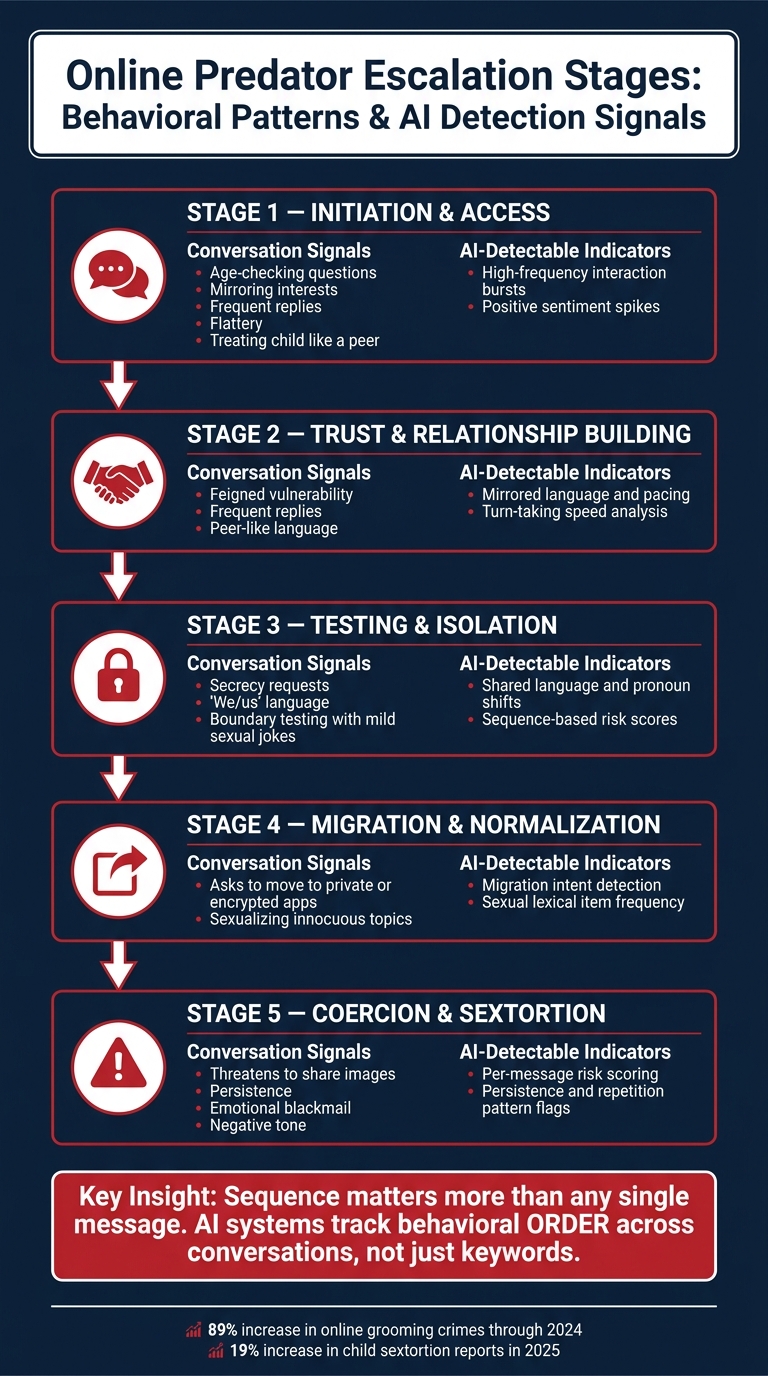
Online Predator Escalation Stages: Behavioral Patterns & AI Detection Signals
Researchers keep finding the same grooming arc: contact, trust, isolation, migration, and coercion. In practice, it often shows up as four main steps: contact, trust, isolation, and coercion.
From First Contact to Relationship Building
It usually starts in a way that looks harmless. An offender opens with age-checking questions that sound casual, then mirrors the child’s interests and replies often to build a sense of closeness. Flattery plays a big role here. That praise is targeted, and it can build trust while falsely boosting a child’s self-esteem.
Another pattern shows up again and again: the offender treats the child like a peer instead of a minor. In some cases, the offender even says outright that they are an adult, hoping that seeming honest will lower suspicion. They may use formal spelling and adult phrasing to make that identity feel more believable. Those early trust signals often come right before requests for secrecy and moves to off-platform communication.
From Secrecy and Platform Migration to Coercion
After trust is in place, the offender asks the target to keep the relationship secret. Then comes pressure to leave public or monitored spaces and switch to private, encrypted channels. Moving from a game chat to a direct messaging app is a critical escalation signal that researchers consistently flag [2].
From there, sexual topics are brought in little by little, often framed as jokes or curiosity. That can lead to requests for images and offers of incentives. If the target pushes back, the offender may threaten to share images, use emotional blackmail, and place the blame on the child. These shifts create some of the clearest real-time signals for automated detection of predator risks.
Escalation Stages, Visible Signals, and AI-Detectable Indicators
| Escalation Stage | Observable Conversation Signals | AI-Detectable Indicators |
|---|---|---|
| Initiation & Access | Age-checking, mirroring interests, frequent replies, flattery, treating child like a peer | High-frequency interaction bursts; positive sentiment spikes |
| Trust & Relationship Building | Treating child like a peer, feigned vulnerability, frequent replies | Mirrored language and pacing; turn-taking speed |
| Testing & Isolation | Asks for secrecy, we/us language, boundary testing with mild sexual jokes | Shared language and pronoun shifts; sequence-based risk scores |
| Migration & Normalization | Asks to move to private or encrypted apps; sexualizing innocuous topics | Migration intent detection; sexual lexical item frequency |
| Coercion & Sextortion | Threatens to share images, persistence, emotional blackmail, negative tone | Per-message risk scoring; persistence/repetition patterns |
What matters most is the sequence: the order of events, how fast things speed up, and how these tactics stack across messages. Real-time AI systems use that same sequence-based logic. Instead of looking only for single keywords, they track behavior across a conversation. That’s where safety teams get the clearest red flags to watch in real time.
Red-Flag Behaviors That Appear Across Studies
These stages stand out most when you group research by the behaviors that keep showing up in direct messages. Study after study, plus case reports, points to the same warning signs: information harvesting, trust testing, secrecy, and emotional pressure. And they don’t show up at random. They tend to appear in a fairly predictable order.
Personal Information Extraction and Trust Testing
Repeated questions about school, daily routines, who’s around, and what devices a child can use aren’t harmless chat. They’re tests of boundaries. Researchers also point to a tactic where the offender treats the child like an adult or a peer, creating a false sense of consent and pushing blame onto the child [1].
Once offenders have a sense of those weak spots, they usually try to cut the child off from other people.
Secrecy Requests, Incentives, and Manipulation Tactics
Secrecy is one of the clearest red flags in the research. When someone asks a child to keep the relationship hidden from parents, teachers, or friends, that’s a deliberate move to isolate them. It strips away outside guardrails that might interrupt the grooming process [2].
Researchers also describe self-victimization ploys, where offenders present themselves as hurt, lonely, or in trouble to stir sympathy and pull the child in more deeply [1]. Another pattern to watch is heavy use of "we" and "you" to blur boundaries and suggest shared responsibility. That kind of wording can push victims toward self-blame [1].
These cues become most useful for detection when they appear as a sequence rather than as one-off messages, and can be analyzed using a threat level calculator.
How AI Detects Behavioral Escalation and What Effective Response Systems Need
Why Sequence Analysis Works Better Than Keyword-Only Detection
Those escalation patterns only matter if a system can read them in order. AI does its best work when it scores a conversation as it unfolds, not when it treats each term like a separate event.
This is called turn-level scoring. The model labels each message as the chat moves forward instead of waiting for the full thread. That matters because the best moment to step in often comes before explicit content shows up. In many cases, the shift happens when a conversation moves from trust-building to compliance testing. A keyword-only system can miss that change. A sequence-based system has a better shot at spotting it early.
Recent studies show that turn-level models can flag risk before explicit content appears. So the job isn't just to score message content. It also has to score message order.
What Response-Ready Systems Should Include
A response-ready system needs more than a warning light. It should include:
- Real-time alerts so teams can act right away
- Plain-English reasons for the flag
- Fast routing to the right human reviewer
Those plain-English reasons matter a lot. A reviewer shouldn't get just a number and have to guess what happened. The system should spell out the pattern it saw, such as secrecy requests or migration after incentives.
Human review still plays a central role. Automated detection surfaces the signal, but a trained reviewer has to interpret it and decide what to do next. And that only works if the alert gets to the right person without delay.
Beyond alerts, response-ready systems also need audit logs and case records. If a conversation is flagged, those records can support law enforcement and internal safeguarding workflows. Multi-language support matters too, since predators operate across borders and use slang, coded language, and non-English text.
Conclusion: Key Patterns Safety Teams Should Watch For
The research points in the same direction: predatory behavior tends to be progressive. It moves through identifiable stages that AI can track across a conversation. The strongest signals usually come from behavioral sequences - information extraction, trust-testing, secrecy requests, and escalation arcs - not from any single word or phrase.
AI should step in early by tracking sequences, not isolated words, and by sending clear alerts to human reviewers.
FAQs
Why does sequence matter more than keywords?
Sequence matters because online grooming is a gradual process, not a single event. Predators usually don’t jump straight to obvious abuse. They often move step by step, starting with mild flattery and then shifting toward isolation or secrecy over time.
That’s where simple keyword filters fall short. A single message might look harmless on its own. But when you look at the order and context of messages, the pattern can tell a very different story.
AI systems such as Guardii do exactly that. They track how a conversation unfolds so they can spot grooming patterns and tell the difference between normal chat and manipulation.
What are the earliest warning signs in DMs?
Early signs of online grooming in direct messages often show up as manipulative language and forced trust-building. A predator may shower a child with compliments, say they’re “mature for their age,” or pretend they’re the only person who gets them.
Other red flags can appear fast:
- quick emotional escalation
- requests to keep the conversation secret
- attempts to pull the child away from friends or family
- a shift toward inappropriate topics
Guardii detects these behavior patterns in real time.
How should teams respond after a high-risk alert?
Teams need to move fast to help stop more harm. Tools like Guardii can help by showing a live, explainable risk score and pattern details, so responders can see how the situation is building over time.
When teams spot signs like platform migration, requests for secrecy, or threats of real-world consequences, they can make better calls and respond in real time before the behavior reaches its target.