

What Happens in Each Stage of Online Grooming
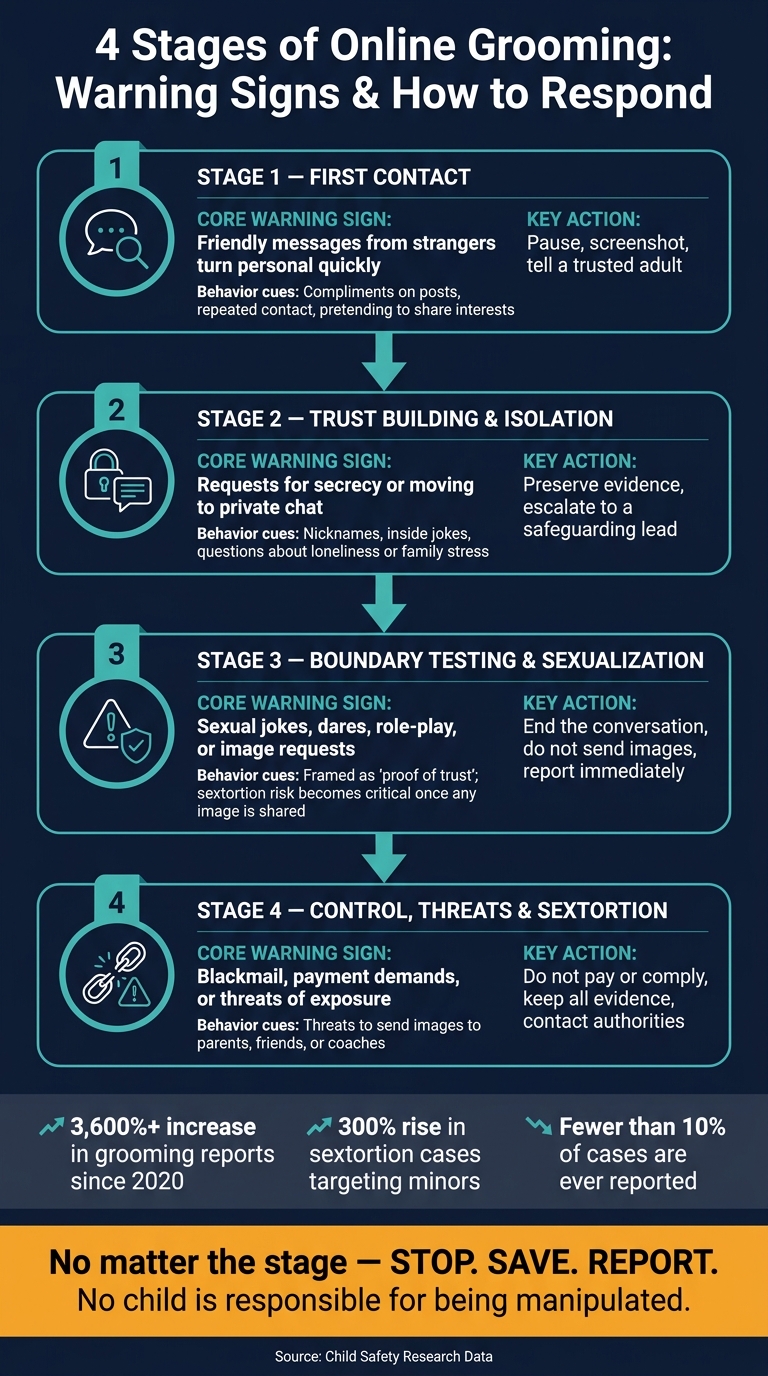
Online grooming often starts with a normal-looking message, then shifts into secrecy, sexual pressure, and blackmail. I’d break it down into four stages: first contact, trust building, boundary testing, and control.
Here’s the short version:
- Stage 1: A stranger tries to get a reply with friendly messages
- Stage 2: The chat gets more personal and moves into private spaces
- Stage 3: Sexual jokes, dares, or image requests start
- Stage 4: Threats, shame, or money demands are used to keep control
A few numbers show why this matters: grooming reports have climbed by 3,600%+ since 2020, sextortion cases targeting minors are up 300%, and fewer than 10% of cases are reported.
What I’d watch for is simple: warning signs of online predators like fast trust, secrecy, sexual talk, and threats. If any of those show up, the best response is the same: stop, save, and report.
This gives me a plain way to spot the pattern early and act before things get worse.
4 Stages of Online Grooming: Warning Signs & How to Respond
5 Warning Signs of Cyber Grooming
sbb-itb-47c24b3
Stage 1: Targeting and First Contact
Stage 1 is about finding a target and starting contact without setting off alarm bells. It tends to be quiet and deliberate. The offender watches public profiles and looks for the easiest opening. That might be a child who posts a lot about feeling lonely, a teen with a public gaming profile, or a young person who often replies to strangers in comment sections. When age, school, location, or daily routine details are public, the target becomes easier to single out.
What Offenders Want and How Early Messages Sound
The aim is simple: get a reply.
Once the target replies, the offender has a path to direct contact. And that direct contact is the main goal. To get there, offenders often act like peers. They may pretend to be the same age or say they’re into the same games, groups, or online spaces.
The first direct message usually sounds completely normal. It might be a compliment on a post, a question about something the target shared, or a casual friendly comment. That normal tone is intentional. It helps the message blend in, which is why Stage 1 can be easy to miss. If the target replies, the offender often moves from first contact into trust building.
When Risk Starts and What to Do Early
The warning signs can show up early. Common behaviors include:
- Watching public profiles
- Joining the same online games or groups as the target
- Sending frequent compliments
- Reaching out again and again after first contact
Kids and teens should be taught to block and report repeated contact from strangers, even when the messages seem harmless or friendly. That repeated contact is often the point where the risk starts moving beyond first contact.
Stage 2: Trust Building and Isolation
After the first reply, the offender often tries to turn a short exchange into a private habit. At that point, the goal shifts. It’s no longer just about getting a response. It becomes about building dependence and cutting down adult visibility.
How Language Changes During Trust Building
The tone usually gets warmer and more personal. Simple small talk starts to turn into nicknames, inside jokes, and longer, more frequent chats. The offender may begin asking pointed questions about feelings, family stress, school problems, or loneliness. Those questions aren’t casual. They’re meant to spot weak points and make the child feel chosen or deeply understood.
Why Secrecy and Private Channels Raise the Danger
When an online contact asks a child to keep the relationship secret or move the conversation off-platform, the risk goes up fast. Secrecy reduces adult oversight and gives the offender more control. Sextortion risk also rises once the offender has private access and emotional leverage.
For parents and caregivers, the safest move is to stay calm and keep the conversation open. Panic can shut a child down. A steadier response helps them keep talking.
At this stage:
- save the chat
- block the account
- report the profile
- tell a trusted adult right away
If you’re a parent or caregiver, respond calmly, keep the child talking, save messages, block the contact, and report the account.
Once the child is isolated and emotionally invested, the next step is usually boundary testing.
Stage 3: Boundary Testing, Sexualization, and Image Requests
After secrecy and private contact, the next step is usually boundary testing. This is where the person starts pushing limits bit by bit before making anything explicit. The goal is simple: make sexual content seem normal without setting off alarm bells.
How Grooming Shifts from Friendly to Sexual
The shift often begins with things that look minor on the surface, like sexual jokes, memes, or dares. That slow move matters. It gives the offender room to test what gets a reaction and what slips by.
Role-play is another common tactic. It lets the offender bring in sexual themes while keeping a bit of distance, as if it’s “just a game.” That buffer can make the situation feel less serious than it is.
Requests for private images often come next. But they usually don’t show up as blunt demands. Instead, they’re framed as proof of trust, closeness, or affection.
When Sextortion Risk Becomes High and How to Respond
Sextortion risk becomes critical the moment any explicit image, video, or live content is shared or saved by the offender. Once that happens, the offender has leverage, and the danger can climb fast.
If this has already happened, take these steps right away:
- Stop responding.
- Save the messages and account details, and learn how to remove nonconsensual intimate images if they have been shared.
- Report the account to the platform, a child-safety hotline, or law enforcement.
- Say clearly that the child is not at fault.
Once an image or video exists, the offender can move from persuasion to control.
Stage 4: Control, Threats, and Ongoing Sextortion
Once the offender has leverage, the conversation changes fast. Pressure turns into threats. By Stage 4, the offender leans on fear, shame, and blackmail to stay in control. The tone that once seemed friendly now turns harsh, threatening, and humiliating. At this stage, the main goal is simple: keep the victim quiet.
What Threats Look Like and What Offenders Want at This Stage
The offender usually wants something specific: control, more content, money, or silence. Many threats center on exposure, such as sending images to the victim’s parents, friends, or coaches. That threat of public shame is meant to shut the victim down.
For schools, clubs, and law enforcement, AI tools can help flag private messages where threats are getting worse and where demands for silence start to appear.
Conclusion: Key Points to Remember at Each Stage
Online grooming often begins like an ordinary chat. Then, little by little, it can shift into isolation, secrecy, and control. That slow change is what makes it hard to spot in the moment.
As messages continue, keep an eye on four signals:
- Is this still ordinary contact?
- Is trust building too fast?
- Is secrecy or sexual content starting to show up?
- Are threats beginning?
Use the table below to connect each stage with the right response.
| Stage | Core warning sign | Key action |
|---|---|---|
| First contact | Friendly messages turn personal | Pause, screenshot, tell a trusted adult |
| Trust building and isolation | Requests for secrecy or private chat | Preserve evidence, escalate to a safeguarding lead |
| Boundary testing and sexualization | Sexual comments or image requests | End the conversation, do not send images, report immediately |
| Control, threats, and sextortion | Blackmail or payment demands | Do not pay or comply, keep evidence, contact authorities |
No child or teen is responsible for being manipulated. Offenders are skilled at making these conversations feel normal and age-appropriate. The child is never at fault.
No matter the stage, the response stays the same: stop, save, and report. Stop the conversation, save the evidence, and tell a trusted adult right away.
FAQs
How can I tell when a normal chat becomes grooming?
A normal chat may start to look like grooming when it stops feeling like simple friendship and starts pushing past limits. The shift often shows up through emotional escalation, secrecy, and boundary testing.
Signs to watch for include:
- intense personal compliments
- pressure to keep the chat private or distrust family and friends
- focus on your routines and struggles
- requests to move to a private app
- inappropriate topics, personal photos, or meeting in person
At what stage does sextortion usually begin?
Sextortion usually starts in the final exploitation phase of grooming. By that stage, the offender has already built trust, pushed secrecy, and created emotional dependence.
Then they start asking for personal content or photos to get leverage. The move from pressure to blackmail is usually the point where grooming turns into exploitation.
What should I do at each stage of grooming?
Act early at each stage.
When someone is trying to build a relationship, keep communication open. Make it easier for your child to talk about online interactions, even the awkward ones. The goal is simple: no silence, no secrets, no room for pressure to grow.
If things move into isolation and dependency, put family boundaries back in place. Be clear that secrecy is a red flag, especially when another person pushes for private chats, emotional dependence, or distance from trusted adults.
In the exploitation stage, requests for photos or in-person meetings often begin. If that happens, save the evidence, block the contact, and report it to local authorities or safety organizations right away.