
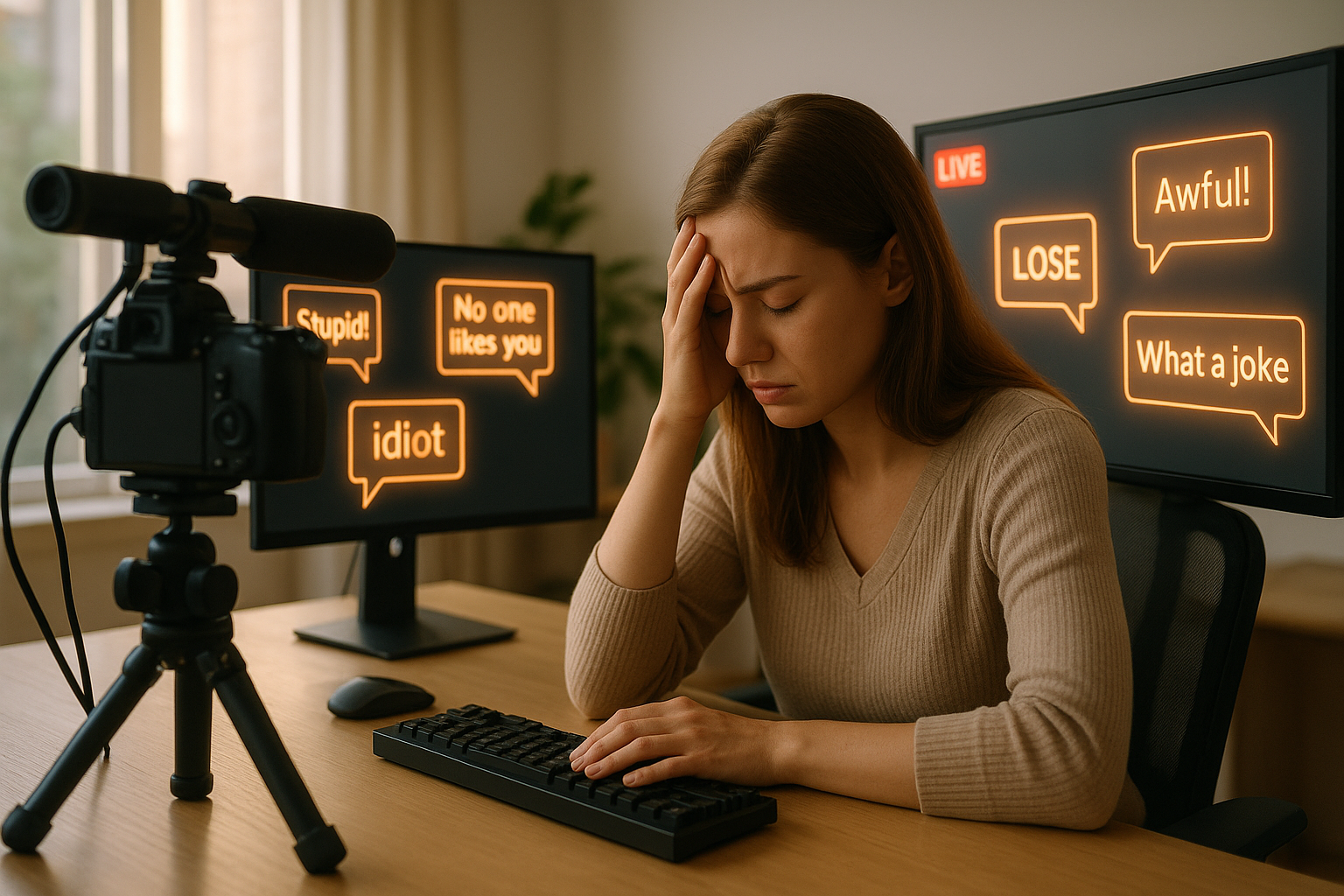
Top Risks in Live Streaming Without AI Moderation
Live streaming is booming, but without proper moderation, it’s a breeding ground for harassment, hate speech, and misinformation. Teens, women, and minorities face the harshest online abuse, with 36% of U.S. teens reporting cyberbullying and 73% of young women encountering unwanted sexual content online. Brands and platforms also risk losing user trust and ad revenue when harmful content isn’t controlled.
AI moderation is a game-changer, enabling real-time detection of abuse, spam, and misinformation while reducing the burden on human moderators. Combining AI with human oversight ensures faster responses, accurate decisions, and safer environments for users, creators, and advertisers. Without these systems, live streaming’s potential for connection can quickly turn into a liability.
Main Risks of Unmoderated Live Streaming
Real-Time Harassment and Hate Speech
One of the biggest dangers of unmoderated live streaming is the immediate exposure to harassment and hate speech. Unlike pre-recorded content, where harmful comments can be filtered out before going public, live streams leave athletes, influencers, and content creators vulnerable to abuse as it happens - right in front of their audience.
Statistics show that 41% of Americans have faced online harassment, with 25% experiencing severe abuse, such as threats or sustained attacks[6]. Women and minorities are disproportionately affected - 67% of women and girls encounter misinformation and defamation online[8], and lesbian, gay, or bisexual adults face harsher harassment compared to their straight peers (51% vs. 23%)[6][7].
During live streams, this abuse often escalates into racial and gender-based slurs, explicit harassment, and even coordinated attacks. The public nature of these incidents magnifies their emotional toll, forcing victims to decide whether to endure the abuse while continuing their stream or cut it short, potentially disappointing their audience.
The psychological effects can be immediate and severe. For instance, 48% of local elected officials have reported being less willing to address controversial issues due to fears of hostility[5]. Similarly, athletes and influencers may avoid certain topics or reduce their online presence altogether to escape the relentless abuse. Adding to this chaos, spam and trolling further disrupt live streams, making the environment even more toxic.
Spam, False Information, and Trolling
Aside from direct harassment, unmoderated live streams often spiral into disorder with spam and trolling. Spam bots flood chat feeds with repetitive messages, promotional links, or irrelevant content, drowning out genuine audience interaction. Meanwhile, coordinated trolling campaigns - where groups bombard the stream with inflammatory or off-topic posts - make it nearly impossible to have meaningful conversations.
Misinformation thrives in live streaming environments. Without proper checks, false claims can spread rapidly as viewers capture and share unverified information before corrections can be made. This not only damages the credibility of the content creator but also undermines trust in the platform itself. Alarmingly, misinformation and defamation are among the most common forms of online violence against women, affecting 67% of women and girls[8].
Brand Safety and Sponsor Risks
Toxicity in live streams doesn’t just harm individuals - it also puts brands and sponsors in a precarious position. If hate speech, harassment, or offensive content emerges during a sponsored stream, brands risk being linked to controversial material. This association can lead to immediate backlash, with sponsors pulling out mid-campaign and causing financial losses for both the platform and the content creator.
Social media platforms, where 75% of online harassment occurs[6], are particularly risky for brands involved in live streaming. Beyond financial consequences, brands can suffer long-term reputational damage, including consumer boycotts and negative media coverage. The fast-paced nature of live streaming means harmful content can be recorded and widely shared, permanently tying brands to problematic incidents.
Legal risks also loom large. Brands connected to content that violates anti-discrimination laws or targets protected groups could face penalties. For example, the REPORT Act in the U.S. has broadened mandatory reporting for online child exploitation, with increased fines for non-compliance[4]. As regulations evolve to address other forms of online harm, the stakes for brands in unmoderated live streams continue to rise.
Private Harassment Through Direct Messages
While public harassment during live streams is highly visible, private direct messages (DMs) pose an equally serious threat. This form of abuse often escalates beyond what’s seen publicly, creating a hidden layer of harm that many moderation systems fail to address.
Shockingly, 80% of grooming cases begin on social media platforms and then shift to private messages[1]. During or after live streams, perpetrators use DMs to send threats, engage in sexual harassment, share explicit images without consent (a practice known as cyberflashing), and conduct sustained intimidation campaigns. Since 2020, online grooming cases have skyrocketed by over 400%, and sextortion cases have risen by more than 250%[1]. While eight out of ten grooming cases start in private messages, the actual numbers are likely higher due to underreporting.
"Unfiltered internet is like an unlocked front door. Anyone can walk in."
- Stephen Balkam, CEO, Family Online Safety Institute[1]
For public figures like athletes and influencers, the sheer volume of private messages during live streams can be overwhelming. This makes it difficult to distinguish between genuine threats and general noise. The anonymity of online platforms emboldens perpetrators, making it harder to trace or stop abusive behavior[5]. As a result, many victims feel compelled to deactivate their accounts to escape the harassment[3].
Using artificial intelligence to automate content moderation and compliance with AWS services
Why Human Moderation Alone Is Not Enough
Human moderators bring valuable contextual judgment, but they simply can't keep up with the demands of live streaming. As live streams generate massive amounts of content at lightning speed, this gap becomes more apparent - and problematic.
The Challenge of Volume and Speed
Live streaming has grown to a scale that human teams alone can't manage. For example, reports of online harassment have skyrocketed, with lifetime incidents climbing from 33.6% in 2016 to 58.2% in 2025. Even short-term victimization rates have doubled - from 16.5% to 32.7% over the same period [2]. Popular live streams often generate thousands of comments every minute, overwhelming moderators and leaving harmful content visible to viewers before it can be addressed.
The issue isn't just about volume - speed is just as critical. Emerging threats like online grooming and sextortion demand immediate action. Since 2020, grooming incidents have surged by over 400%, while sextortion cases have increased by more than 250% [1]. These threats evolve too quickly for human moderators to respond effectively.
"The research clearly shows that preventative measures are critical. By the time law enforcement gets involved, the damage has often already been done."
Adding to this urgency, only 10–20% of online predation cases are ever reported, and law enforcement acts on just 12% of those reports [1]. This underscores the need for rapid, scalable solutions to detect and address threats in real time.
Inconsistencies in Human Moderation
Human judgment, while nuanced, can be inconsistent. Moderators often interpret the same content differently based on their personal experiences, cultural backgrounds, or varying understandings of platform guidelines. This inconsistency becomes especially problematic on platforms like Instagram and Facebook, where cyberbullying rates have reached 30% and 26%, respectively [2].
The problem worsens when moderation teams are large and globally dispersed. Language barriers and cultural differences can lead to conflicting decisions - what one moderator deems acceptable might be flagged as harmful by another. This lack of clarity erodes user trust and creates confusion about what content is actually allowed.
The High Cost of Scaling Human Moderation
Expanding human moderation to operate 24/7 across multiple languages requires massive resources. Recruiting, training, and supporting these teams is expensive, and the emotional toll on moderators - who often face constant exposure to abusive content - leads to burnout. This not only affects their well-being but also reduces the quality of their decisions, further straining resources.
Financially, relying solely on human moderation becomes unsustainable. With online harassment incidents rising sharply - from 5–6% between 2015 and 2021 to 16.1% in 2025 [2] - the costs of scaling human efforts continue to climb, making it clear that this approach alone isn't enough.
sbb-itb-47c24b3
How AI Moderation Solves These Problems
AI moderation is reshaping live streaming safety by tackling challenges that human moderators often struggle with. While human teams can be overwhelmed by the sheer volume of content, the speed at which it appears, and the need for subjective decisions, AI steps in to handle these issues efficiently. By processing vast amounts of content in real time and maintaining consistent standards, AI systems address some of the most pressing risks in live streaming.
Real-Time Detection of Harassment and Abuse
AI moderation tools use machine learning models trained on extensive datasets of abusive language to identify and block harmful content instantly during live streams. These systems analyze text, audio, and video cues simultaneously, allowing for immediate action to protect both streamers and their audiences.
For example, in 2025, YouTube Kids deployed AI filters that blocked offensive language, leading to a 30% drop in reported incidents [9]. Similarly, Xbox Trust & Safety's real-time detection flagged an average of 9,700 abuse cases daily within gaming communities [9]. AI can recognize a wide range of harmful behaviors, including hate speech, body shaming, gender-based insults, threats, sexual harassment, and targeted bullying. Data from 2025 revealed that 47% of flagged keywords were gender-specific insults, and 12% of users reported experiencing sexual harassment online [9][3]. Advanced models are even capable of identifying newer threats, like voice cloning harassment, which affected 11% of U.S. high schoolers using voice chat apps [9].
Spam and False Information Control
AI moderation tools use pattern recognition, natural language processing, and anomaly detection to combat spam and misinformation. These systems can quickly identify repetitive spam messages, coordinated misinformation campaigns, and bot-driven content, flagging and blocking them in milliseconds. This rapid response is especially important during live streams, where unchecked spam or false narratives can quickly disrupt the experience. Beyond spam detection, modern AI models are equipped to understand linguistic nuances, ensuring more accurate moderation across languages.
40+ Language and Context Sensitivity
AI systems are capable of understanding content in over 40 languages. They are trained to detect nuances, slang, and context-specific meanings, which helps reduce false positives and ensures that moderation decisions are accurate. This multilingual capability is essential for global platforms, where harmful behavior transcends language barriers.
One example is Guardii, which provides AI-driven moderation for Instagram comments and direct messages in more than 40 languages. Guardii’s system automatically hides toxic comments and detects threats while considering local contexts, ensuring moderation is both precise and inclusive.
Private Message Moderation with Evidence Creation
AI can also monitor private messages for threats, harassment, and other abusive behaviors. Harmful content can be flagged or quarantined before it reaches the recipient, a critical feature given that 80% of grooming cases begin in private messages [1].
Additionally, AI systems create evidence packs and audit logs for safety teams and law enforcement. This documentation is crucial for addressing the reporting gap - only 38% of social media bullying victims reported abuse to authorities in 2025 [9][3]. When suspicious content is detected, it is securely stored as evidence, complete with detailed threat information, for potential legal action.
This capability is especially important given the scale of online abuse. Since 2020, grooming cases have risen by over 400%, while sextortion cases have increased by more than 250% [1]. With only 10–20% of incidents reported to authorities and law enforcement acting on just 12% of reported cases, AI-powered evidence creation plays a vital role in protecting users and supporting investigations.
Combined AI and Human Moderation Approach
Protecting live streams effectively means blending the speed of AI with the judgment of human moderators. This partnership acknowledges a simple truth: neither AI nor humans alone can tackle the complexity and sheer volume of modern live streaming challenges. Together, they create a balanced system that adapts to the ever-changing landscape of online threats.
AI for Scale and Speed
AI moderation systems are built to handle the rapid pace and enormous volume of live streaming content - something human teams simply can't match. These systems can process thousands of messages every second, flagging or removing harmful content almost instantly. This is critical on platforms like Instagram, where nearly 30% of users report experiencing cyberbullying incidents [2].
AI's ability to act in real time makes it an invaluable tool during fast-moving live streams. For example, many AI systems already operate around the clock, creating a constant line of defense that doesn’t suffer from fatigue or delays.
This constant monitoring ensures that harmful content is addressed before it gains traction or spreads further. This is particularly important given that 80% of grooming cases begin on social media platforms and quickly transition to private messages. Rapid detection in these scenarios can make a significant difference in preventing harm [1].
Human Moderators for Complex Cases
While AI shines in handling large volumes of straightforward cases, some situations require the nuanced understanding that only humans can provide. Human moderators are indispensable when it comes to addressing edge cases that demand context, such as distinguishing heated debates from harassment, interpreting local slang, or resolving disputes about flagged content.
Human involvement becomes even more critical in sensitive situations, such as threats, hate speech, or cases involving minors.
"Kids are tech-savvy, but not threat-savvy. They need guidance, not just gadgets." – Susan McLean, Cyber Safety Expert, Cyber Safety Solutions [1]
Additionally, human moderators play a vital role in reviewing evidence packs and audit logs generated by AI systems. They make informed decisions about whether to escalate cases to legal teams, contact affected users, or report incidents to authorities. These tasks require a level of context and judgment that AI currently cannot replicate.
Feedback Loops and Continuous Improvement
The real strength of combining AI and human moderation lies in the feedback loop it creates. Human moderators review AI-generated decisions, correct mistakes, and provide examples of complex cases. This ongoing process helps retrain AI models, making them more effective over time.
These feedback loops enable AI systems to adapt to new challenges, such as emerging slang or evolving harassment tactics. When human moderators flag false positives or identify threats that AI missed, this information feeds directly into improving the system’s accuracy, striking a better balance between over-moderation and under-moderation.
This dynamic interaction ensures that both AI and human components stay aligned with platform policies and user safety priorities. Regular training and evaluation keep the system evolving, creating a mutually reinforcing relationship where AI and human moderators enhance each other’s effectiveness. Together, they provide the speed, scale, and judgment needed to protect live streaming communities in today’s fast-paced digital world.
Conclusion: Creating Safe Live Streaming Environments
Unmoderated live streams are becoming breeding grounds for serious risks. Recent statistics paint a grim picture: harassment is rampant, and cases of child enticement have skyrocketed by 77%, climbing from 292,951 to 518,720 in just six months of 2025 [6][4]. This isn't just about individual harm - it’s reshaping public spaces. Nearly half (48%) of local elected officials now hesitate to address controversial topics due to the hostile online environment [5]. The consequences ripple far beyond personal safety, threatening public discourse and trust.
To tackle these growing dangers, AI-powered moderation has emerged as a game-changer. Unlike human moderators, who can be overwhelmed by sheer volume and speed, AI systems excel at processing massive amounts of content across 40+ languages, all while applying consistent rules. Tools like Guardii.ai illustrate this potential by automatically hiding harmful comments, detecting threats in direct messages, flagging sexualized harassment, and compiling evidence for legal and safety teams. These systems not only protect users but also help maintain a positive environment for creators and preserve brand reputations.
The real strength lies in combining AI and human moderation. AI manages the heavy lifting - scaling to meet demand and responding instantly - while human moderators step in for nuanced cases and refine the system over time.
The urgency is clear: platforms must embrace real-time AI moderation to shield creators, brands, and audiences from the rising tide of toxic content. The stakes couldn’t be higher. Choosing to implement AI-driven moderation is more than a step toward safety - it’s a commitment to the future of live streaming as a trusted and constructive space for communication.
FAQs
How does AI moderation make live streaming safer and more enjoyable compared to relying solely on human moderators?
AI moderation plays a crucial role in improving the safety and quality of live streaming by tackling challenges that human moderators often find difficult to manage alone. One of its key strengths is operating round-the-clock, processing massive amounts of content in real time to identify and address harmful behaviors like harassment, abuse, or hate speech. This helps create a safer space for both streamers and their audiences.
Unlike human moderators, AI systems excel at analyzing patterns and spotting toxic behavior across different languages and platforms on a large scale. They also respond much faster, minimizing the chances of harmful content spreading. For instance, tools like Guardii.ai offer features such as auto-hiding offensive comments, identifying threats in private messages, and generating detailed evidence logs to assist legal or safety teams. By combining speed, precision, and scalability, AI moderation ensures a more secure and enjoyable live streaming environment for everyone involved.
What legal and financial risks could brands face from unmoderated live streams?
Unmoderated live streams can put brands at risk, both legally and financially. Without proper oversight, harmful actions like harassment, abuse, or hate speech can surface during broadcasts. These incidents can lead to lawsuits, regulatory fines, or lasting damage to a brand's reputation. This is particularly concerning for brands linked to public figures, events, or influencers, where their identity is deeply tied to the live content.
On the financial side, the fallout can be severe - brands might lose sponsorships, see customer trust erode, and face expensive crisis management efforts if offensive content sparks public outrage. Using advanced AI moderation tools offers a proactive solution. These tools can step in during live streams, identifying and managing harmful behavior in real-time, helping to safeguard a brand's reputation and ensure a safer environment for everyone involved.
Why is it important to tackle harassment in direct messages during live streams?
Direct messages (DMs) during live streams can sometimes become a hidden space for harmful behavior. These private conversations are often where issues like grooming, targeted abuse, or harassment start. If left unchecked, DMs can quickly turn into a hub for threats, inappropriate content, and other toxic interactions, putting individuals' safety and mental health at risk.
This is where AI-powered moderation tools step in. These tools can spot toxic language, flag problematic messages, and even provide evidence for follow-up actions. By taking a proactive approach to managing DMs, creators, athletes, and their communities can enjoy a safer space - one that protects personal well-being and safeguards reputations.