

How UAE's 2027 Law Impacts CSAM Detection Tech
If your platform uses end-to-end encryption, the UAE’s January 1, 2027 rule changes the job right now. I’d boil it down to this: content-only moderation will not be enough, server-side scanning will hit limits in private messaging, and teams will need behavior-based detection, human review, logging, and clean evidence handling.
Here’s the short version in plain English:
- The deadline is January 1, 2027
- Platforms in scope need support for:
- age checks
- content filtering
- parental controls
- law-enforcement cooperation
- E2EE blocks server visibility, so private-message detection gets much harder
- That leaves 3 main paths:
- server-side scanning
- client-side scanning
- behavioral detection
- The hard part is not only finding risk
- It’s also:
- cutting false positives
- sending high-risk cases to human review
- logging each decision
- building evidence packs
- keeping data access tight
If I were planning for 2027, I’d focus on two things first: how risk is detected in encrypted chats and how each alert moves from flag to review to referral. That is where privacy, legal exposure, and day-to-day workflow meet.
A quick side-by-side helps:
| Approach | Works with E2EE? | Main use | Main issue |
|---|---|---|---|
| Server-side scanning | Mostly no | Read content on provider systems | Fails when message content stays encrypted |
| Client-side scanning | Yes, before encryption | Inspect content on device | Privacy concerns and rollout friction |
| Behavioral detection | Yes | Spot grooming, sextortion, and escalation patterns from interaction signals | Needs tight review rules to control error rates |
What stands out to me is simple: the law pushes detection closer to the product itself. Architecture choices now affect compliance. And for private messaging, behavioral AI plus audit-ready review flows looks like the most workable path without giving up encryption outright.
Child Sexual Abuse Material (CSAM) Online: Detection Myths vs Fact | IWF
The problem: why CSAM detection is difficult in encrypted messaging
Proactive detection gets much harder when encryption blocks server access. Once end-to-end encryption is in place, the platform can’t read message content on its servers. So if a company wants to detect CSAM before reports come in, it has to rely on other methods.
That’s why the UAE deadline creates a technical constraint, not just a legal one. In practice, platforms are left with three main paths: server-side scanning, client-side scanning, and behavioral detection.
Server-side scanning, client-side scanning, and behavioral detection compared
Three approaches matter here, and each comes with trade-offs that become more urgent under the UAE’s January 2027 deadline.
Server-side scanning only works when the provider can read the content. If messages stay encrypted end to end, that path largely disappears.
Client-side scanning checks messages on the user’s device before encryption. That can help with detection, but it also brings privacy concerns and rollout risk. Put simply, it moves inspection from the server to the phone.
Behavioral detection takes a different route. Instead of reading message content, it looks at interaction patterns, escalation signals, and interaction patterns. That makes it the best fit for encrypted settings where server access to content isn’t available.
Each method handles one part of the problem. But none comes free. Every option adds a new layer of risk.
Privacy, civil liberties, and operational risks
These trade-offs aren’t only technical. They’re legal and operational too.
Proactive detection can create privacy concerns when it depends on collecting more data than a platform needs. False positives can lead to wrongful reports. False negatives can let abuse slip through. That’s the tightrope.
To deal with that, platforms need clear detection rules, human review gates, and escalation paths. If those guardrails are weak, even a well-meant system can go sideways fast.
How the UAE's approach fits the global policy shift
The UAE reflects a broader move toward earlier intervention in private messaging. Regulators are no longer relying only on after-the-fact reporting. More and more, they want platforms to build proactive detection into their compliance workflows.
That shifts the pressure onto product and system design. Architecture, logging, and review workflows are no longer just engineering choices. They’ve become compliance decisions.
For encrypted messaging, technical architecture is now a legal issue. The next question is which of these approaches can support compliance without breaking encryption.
Detection approaches that can support compliance
Compliance in encrypted messaging takes more than one scanner. It needs a layered setup: detection that reads context, human review, and an escalation path that can stand up to scrutiny. In practice, the method matters less than the workflow around it.
Behavioral AI for grooming, sextortion, and escalation patterns
Behavioral detection looks at how a conversation unfolds, not just the words inside a single message. That makes it useful for spotting escalation patterns like platform migration, information extraction, incentive-offering, requests for secrecy, and threats of real-world consequence.
These systems can review direct messages in real time and assign a risk score with pattern-based explanations. They can flag grooming progression, sextortion escalation, and related abuse patterns within each message thread.
Hybrid and AI-assisted workflows for triage and evidence handling
Once a system spots risk, the harder part begins: turning that signal into a case that holds up. Compliance workflows need to do more than fire off a single alert. AI can triage conversation context and escalation signals, send high-risk cases to human review, and help assemble evidence for referral.
For platforms getting ready for 2027, the key is clear documentation of how detection, review, and escalation work together. A defensible workflow should record the alert, the review decision, and the referral path. The next step is showing that those alerts can move cleanly into review and referral.
sbb-itb-47c24b3
Governance and implementation: building a compliance model before 2027
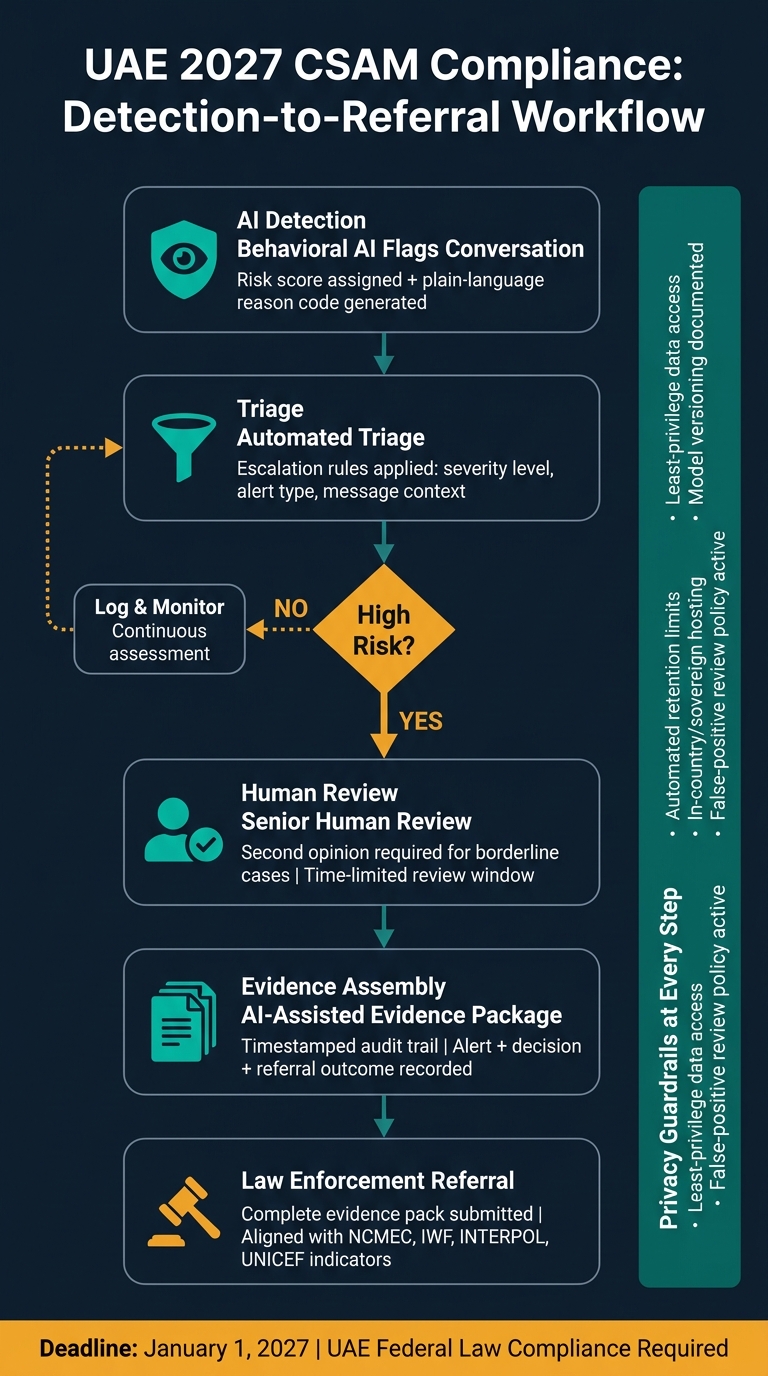
UAE 2027 CSAM Compliance: Detection-to-Referral Workflow
Getting detection right is only half the job. The other half is building a governance setup that can stand up to review from regulators and your own legal team.
A sound compliance model isn't just about having AI in place. It means being able to show how each alert was handled, who reviewed it, what they decided, and why.
A step-by-step compliance workflow from detection to referral
A solid workflow should log every alert, review, and referral, along with a short note on the grooming behavior that triggered it.
When an AI system flags a conversation, it should assign a risk score and include a plain-language reason code. After that, the workflow needs clear escalation rules:
- Which alerts need senior review
- When a second opinion is required before referral
- How much time each step can take
Each decision point should create a timestamped audit trail entry that records the alert, the reviewer's decision, and the referral outcome.
If a case is referred onward, the evidence package should be complete at the time it is assembled, not pieced together later. Some systems use AI-assisted pipelines to triage threats, assemble evidence packs, and escalate cases with human review. The next issue is simple: can that alert make it through review, logging, and referral without weakening privacy controls?
Privacy-respecting design choices for regulated markets
That workflow only works if the system follows strict data limits.
Use least-privilege access. The system should only access what it needs to assess risk, and only for as long as needed. In practice, that means data minimization, retention limits, and automated controls instead of manual workarounds.
These controls matter because encryption limits inspection. So governance has to show that the system uses only the minimum data needed. Use in-country or sovereign hosting where required to limit cross-border exposure and make compliance easier to document.
Teams should also document model versioning and testing: which version is running, how it was tested, how false positives are handled, and how edge cases are reviewed. This often involves transfer learning in grooming detection to adapt models to evolving threats.
What decision-makers should document before 2027
Before January 1, 2027, teams should document the controls below.
| Document or Review | What It Should Cover |
|---|---|
| Legal review | Jurisdictional obligations, referral requirements, liability exposure |
| AI risk assessment | Model accuracy, bias testing, false-positive rates, edge-case handling |
| Encryption impact review | Which detection methods apply to which message types |
| Model-testing standards | Benchmarks, test datasets, update cadence |
| False-positive handling policy | Review process, analyst authority, user impact controls |
| Staff escalation playbooks | Role-specific decision trees, escalation timelines, law-enforcement contacts |
| Source-alignment documentation | Alignment with indicators from NCMEC, the Internet Watch Foundation, INTERPOL, and UNICEF |
For behavioral detection models, it is especially important to record which indicators informed the model, how they were built into the model, and when the model was last reviewed against the UAE's January 2027 compliance deadline.
Conclusion: what the UAE's 2027 law means for CSAM detection technology
The January 1, 2027 deadline leaves little room for slow, after-the-fact moderation. For encrypted messaging platforms and institutions, reactive moderation just isn't enough anymore.
Simple keyword filters don't catch grooming patterns like compliments, age-related questions, or requests to continue the conversation somewhere else. Human review has the same problem in a different way: it can't keep up at scale.
What works is a detection layer paired with a tight response workflow. The strongest compliance model brings together behavioral AI, structured governance, and tamper-evident evidence handling. It needs to detect intent, score severity, package evidence, and send high-risk cases to human review.
FAQs
Does the UAE law apply to encrypted messaging apps?
Yes. The UAE’s upcoming child digital-safety law requires AI-based detection that works in advance on messaging platforms. That includes places where predators often hide, like private and encrypted chats.
Put simply, platforms can’t limit child-safety efforts to public spaces. They also need to deal with risks inside private messaging to help protect children from grooming and other predatory behavior.
How can platforms detect CSAM without reading message content?
Platforms can spot predatory activity more reliably when they look beyond keyword filters and pay closer attention to behavioral patterns and the way a conversation unfolds.
That matters because harmful behavior often isn't tied to one obvious word. It shows up in how someone communicates. AI systems can review message timing, frequency, tone, and signs of grooming escalation, including secrecy requests, attempts to move the chat to another platform, or unusually fast emotional bonding.
This gives platforms a way to support real-time risk scoring and intervention without depending only on single words or fixed keyword lists.
What should teams document before January 1, 2027?
Teams should document their AI detection and moderation workflows with a clear audit trail from first flag to possible prosecution.
That means showing what was detected, when it was detected, who reviewed it, what action was taken, and why. If the case moves beyond moderation, the record should still hold up. A clean trail matters here. Without it, even a strong case can fall apart.
The documentation should also cover message storage for thread continuity. One message on its own can be misleading. A full thread gives the context needed to judge intent, pattern, and severity.
Evidence handling needs the same level of care. Teams should spell out how they build tamper-evident evidence packages so records can be checked later and trusted during internal review or legal action.
Just as important, the system should explain how it scores risk and labels abuse. If a score says a case is high risk, reviewers need to know what drove that result. The same goes for classification. The workflow should show how abuse is grouped by severity and jurisdiction, so the right teams can respond under the right rules.