

UAE Child Safety Laws and Encrypted Messages
If your platform serves kids in the UAE, encrypted DMs are now the hardest part of compliance.
I’d boil the article down to this: the UAE now expects platforms to find child-safety risk in messaging, not just react after a report. Since end-to-end encryption blocks message reading, the main path is behavior signals, metadata, age checks, restricted private messaging for minors, and audit logs that TDRA can review.
Here’s the short version you can act on:
- The law is already in force: Federal Decree-Law No. 26 of 2025 started on January 1, 2026
- Penalties can start on: January 1, 2027
- Messaging apps are covered, including private communications
- AI and machine learning are required for finding and removing harmful material
- End-to-end encryption creates a blind spot, because platforms often can’t inspect message content
- Cabinet Resolution No. 106 of 2026 treats unrestricted private messaging as a high-risk feature for minors
- Behavior-based detection is the main workaround: look for grooming behavior, coercion, secrecy requests, app-switch attempts, and contact patterns
- Age checks can’t stop at signup; platforms may need repeat checks when risk signs appear
- Audit trails matter because regulators can review systems, actions, and reports
- U.S.-based platforms serving UAE users are still in scope
A few numbers from the article stand out. Among UAE children ages 10–14, 71% of inappropriate-content access incidents happened on devices without parental controls, and 43% of children had already found a workaround even when controls existed, often with VPNs. That helps explain why private chats have become the pressure point.
If I were summarizing the article for a compliance or safety team, I’d say this: you do not need blanket decryption, but you do need a system that can flag risk in encrypted spaces, explain why it flagged it, and keep records of what happened next.
| Issue | What the article says |
|---|---|
| Law start date | January 1, 2026 |
| Penalty exposure | January 1, 2027 |
| Main regulator | TDRA |
| Hardest gap | Encrypted private messages |
| Main detection path | Behavior-based AI plus metadata signals |
| High-risk minor feature | Unrestricted private messaging |
| Key proof for regulators | Logs, reports, and reviewable controls |
So the core message is simple: the UAE has shifted from after-the-fact takedowns to risk detection before harm spreads, and encrypted messaging is where that shift gets tested most.
UAE legal framework for child digital safety and messaging
Federal Decree-Law No. 26 of 2025: scope and key duties
Federal Decree-Law No. 26 of 2025, the Child Digital Safety (CDS) Law, sits at the center of the UAE’s push to protect minors online. It applies to platforms that reach users in the UAE and requires proactive child-safety controls. For encrypted messaging services, that creates a clear tension: they still have to meet the law’s child-safety duties even when they can’t fully see message content.
The law says platforms must use AI and machine learning to proactively detect, remove, or report harmful content [1][2]. It also requires age verification, age-based content classification, default high-privacy settings for children’s accounts, and simple ways for users to report CSAM to authorities [9][1]. For children under 13, platforms cannot collect or process personal data unless they have explicit, documented, and verifiable parental consent [1][2].
TDRA is the main enforcement body. It can order the removal or blocking of unlawful material [9][6]. If a platform does not comply, it can face suspension or partial or full blocking of its services in the UAE [9][1][5][6].
Related UAE laws that affect messaging safety
The CDS Law does not stand alone. It works alongside Wadeema's Law and the Cybercrime Law.
Wadeema's Law established every child’s right to protection from abuse [3]. The Cybercrime Law, Federal Decree-Law No. 34 of 2021, takes a more reactive approach. It focuses on penalizing illegal digital acts and removing content after that content is reported [1]. The CDS Law moves past that model by requiring platforms to look for harmful content before anyone reports it [1][3].
That shift matters even more in encrypted messaging, where harmful activity may not be visible in plain text.
Cabinet Resolution No. 106 of 2026 adds another layer. It restricts social media access for children under 15 and requires platforms to watch for signs that users are trying to get around age checks, including VPN use [10]. So interoperable age verification is no longer just a signup task. It becomes an issue platforms have to keep tracking over time.
Where UAE law points toward detection requirements
Put together, these rules push platforms away from a passive notice-and-takedown model and toward proactive systems that can be reviewed by regulators [1][4]. A written policy alone won’t cut it. Platforms are expected to run real-time systems that regulators can inspect [4].
For encrypted messaging, that leads to a plain problem: platforms need ways to spot risk without leaning only on user reports. In practice, the legal direction points toward monitoring behavioral signals, limiting data collection for minors, and running repeat checks when risk signals appear instead of treating onboarding as a one-and-done step [2][4].
The UAE standard is proactive, real-time, and auditable rather than reactive takedown after a report. In encrypted chats, that moves the core issue from legal duty to technical visibility.
sbb-itb-47c24b3
What research says about end-to-end encryption and child safety enforcement
How encryption limits detection visibility
End-to-end encryption (E2EE) is built to keep messages private. The tradeoff is pretty direct: platforms can't see what happens inside private chats. So when grooming attempts or CSAM exchanges happen in apps like WhatsApp, Telegram, Signal, or Discord, platform servers and standard monitoring tools can't inspect the message body [7].
That also means server-side hash matching can't scan encrypted message content. In practice, the main thing left to analyze is behavior rather than text.
Research points to a related problem on the device side. Among children ages 10–14 in the UAE, 71% of inappropriate content access incidents happened on devices with no parental control software installed [7]. And even when controls were turned on, 43% of children had already found a workaround, most often through VPN apps [7].
As Fakhruddin Shabbir, a UAE-certified tech expert, put it:
"End-to-end encrypted messaging... means content shared between peers is invisible to device-level monitoring and most parental control apps." [7]
How the EU, UK, and child-protection bodies have responded
No major jurisdiction has fully solved the tension between encryption and child safety enforcement. The UK and EU both require platforms to look at child-safety risk, but neither requires blanket decryption.
The UK's Online Safety Act puts a proactive duty of care on platforms. The EU Digital Services Act uses a risk-based model and requires Very Large Online Platforms to carry out systemic risk assessments and put mitigation measures in place. The UAE CDS Law also reaches beyond national borders: it applies to platforms targeting UAE users no matter where the company is based [4][11].
For encrypted messaging, that pushes detection away from message content and toward metadata and behavior signals.
Technical options studied as alternatives to blanket decryption
Researchers and regulators have looked at a few options that don't require breaking encryption outright. The three most discussed are client-side analysis, metadata-based detection, and behavioral modeling.
Client-side analysis runs safety checks on the device before a message is encrypted and sent. In theory, it can detect known CSAM hashes without exposing message content to platform servers. The catch is that it depends on device-level access.
Metadata-based detection focuses on signals around the message, such as timing, frequency, account age, contact patterns, and group membership. It doesn't read message bodies, but it can still flag unusual activity.
Behavioral modeling is the option that lines up most closely with the UAE CDS Law. Instead of scanning for certain words or known file hashes, it trains AI systems to spot grooming patterns and escalation arcs that may point to coercion, using signals that don't rely on plaintext access [1][4].
At that point, the debate shifts. It's less about whether platforms should decrypt messages and more about which non-content signals are strong enough to support dependable detection.
| Approach | What It Can Detect | Key Limitation |
|---|---|---|
| Client-side hash matching | Known CSAM files | Requires device-level access |
| Metadata-based detection | Anomalous contact patterns | Limited context |
| Behavioral modeling | Escalation arcs, grooming sequences | Requires behavioral ontologies |
The practical issue is figuring out which signal layers can still work when decryption is off the table.
Behavior-based AI detection in private and encrypted messaging
Detecting grooming, sextortion, and coercive escalation through behavior signals
When platforms can't read plaintext, they have to look at behavior. That's where this approach starts.
Grooming and sextortion usually don't hinge on one obvious message. They tend to move in patterns over time: a steady escalation across a conversation, not a single line that sets off alarms [8]. That matters, because a model trained only to catch illegal keywords can miss the slow pressure that shapes most coercive exchanges.
Some of the clearest signals include:
- Personal-data probing like asking for a school name, location, or daily schedule
- Offers of gifts or rewards
- Requests for secrecy
- Attempts to move the child to a more private app
- Offline retaliation threats when a child tries to pull away
Taken together, those actions can tell a much clearer story than isolated words ever could.
How explainable AI can work without exposing message content at scale
Spotting risk is only half the job. A system also has to show why it flagged something.
Explainable AI does that by giving reviewers both a risk score and the behavior triggers behind it. For example: "secrecy request followed by app migration attempt." That kind of explanation supports human-in-the-loop review, where an analyst checks the alert before deciding whether full-thread access is needed.
That paper trail also matters for compliance. UAE Federal Decree-Law No. 26 of 2025 requires platforms to submit periodic statistics and reports on measures taken [3][4]. So traceable alerts and action logs aren't just nice to have. They're part of what makes the system usable in practice.
Risk scoring, explanation, and audit logs make behavior-based detection workable for compliance without blanket decryption.
Guardii as an example of behavior-focused detection
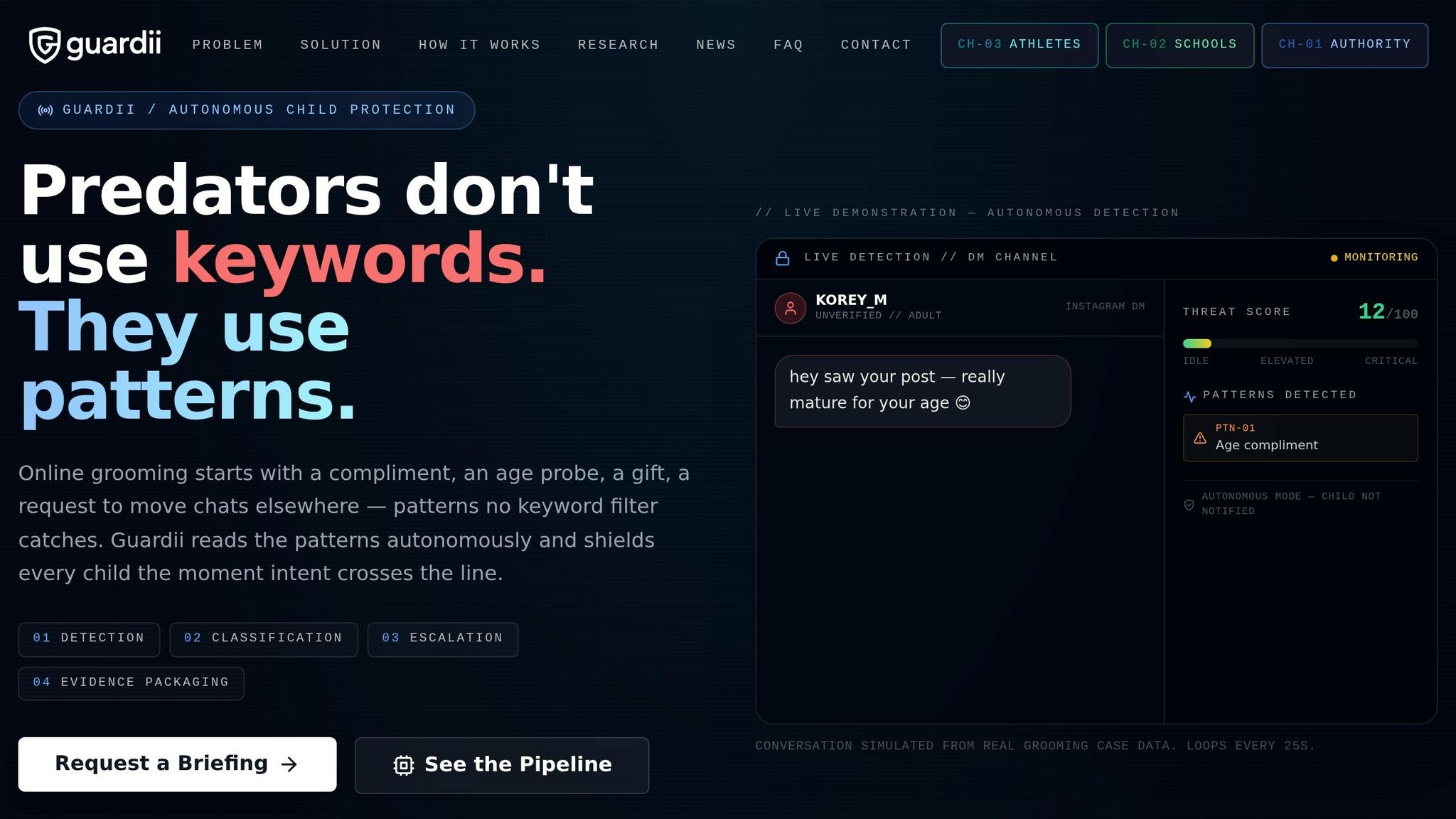
You can already see this model in behavior-focused safety tools. Guardii is one example.
Its AI is trained on behavior patterns tied to grooming progression, sextortion escalation, and coercive tactics. It shows a live, explainable risk score along with a plain-English pattern summary. In plain terms, it tries to flag the arc of pressure inside private messages, not just hunt for banned words.
Guardii shows how behavior-based detection can be put to work while still keeping the audit trail required under the UAE Child Digital Safety Law by January 1, 2027 [1][2].
UAE Bans Social Media Accounts for Children Under 15 in Major Move | NewsX
What UAE, MENA, and U.S.-based safety teams should do now
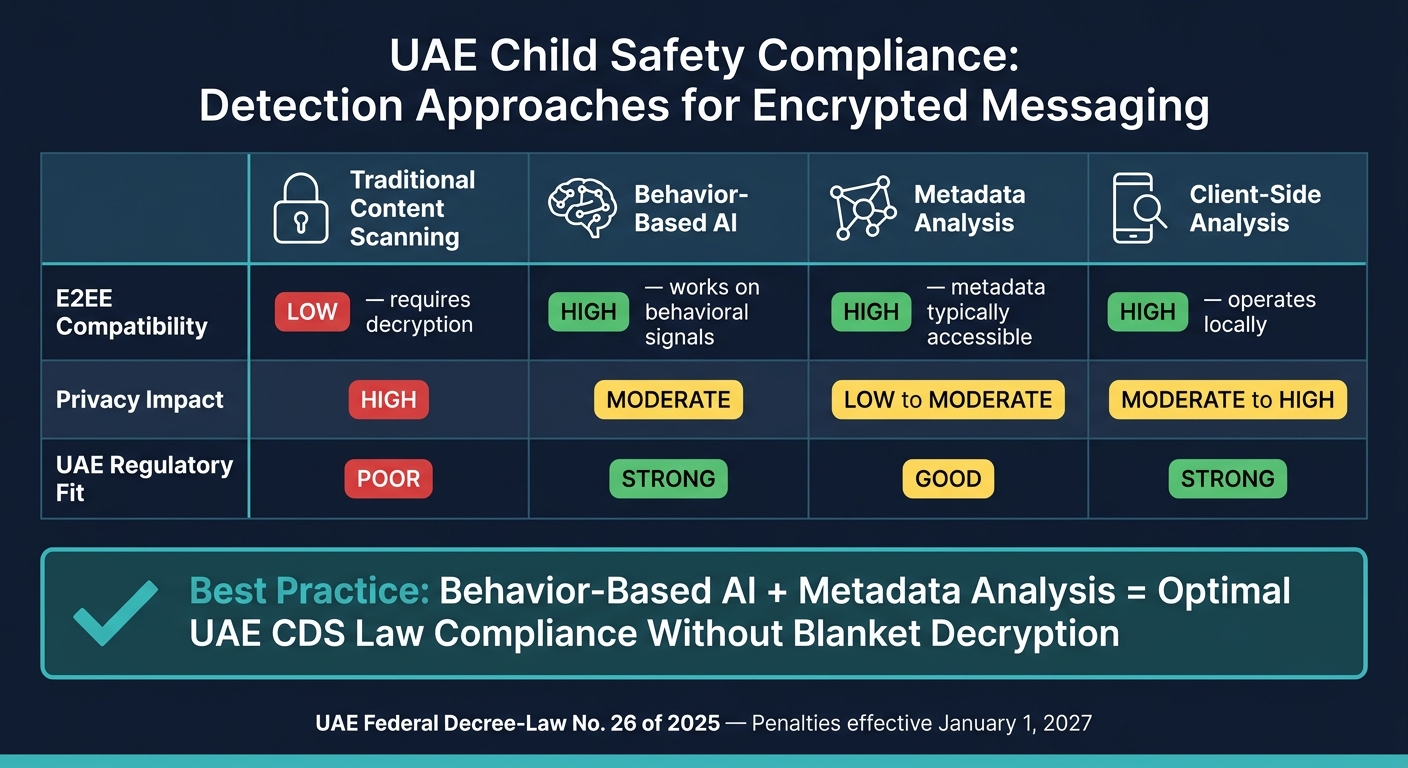
UAE Child Safety Law: Encryption Detection Approaches Compared
What compliance teams need to plan for
Compliance teams now need child-safety controls across the entire product, with extra attention on private messaging. At this point, the debate isn't about legal theory. It's about rollout.
In practice, detection needs to work without access to plaintext. Teams should review every place where minors can send or receive messages, put AI detection of grooming tactics in place with high-privacy settings turned on by default for users under 18, and add controls that curb unsolicited or repeated contact [2]. Age checks should use layers, pairing AI-based age estimation with government ID verification such as UAE Pass [10]. Teams also need audit-ready records of risk reviews and mitigation steps for periodic reporting to the Child Digital Safety Council [2].
Platforms based in the U.S. that serve UAE users need these same controls [11].
Comparison of detection approaches and regulatory fit
For compliance teams, the choice comes down to four main paths:
| Detection Approach | E2EE Compatibility | Privacy Impact | UAE Regulatory Fit |
|---|---|---|---|
| Traditional Content Scanning | Low - requires decryption | High | Poor |
| Behavior-based AI | High - works on behavioral signals | Moderate | Strong |
| Metadata Analysis | High - metadata typically accessible | Low to moderate | Good |
| Client-side Analysis | High - operates locally | Moderate to high | Strong |
These tradeoffs make behavior-based detection the most practical default under UAE rules. Paired with metadata analysis, it gives teams the best mix of E2EE compatibility, privacy protection, and regulatory fit without relying on blanket decryption [1][2].
Conclusion: What law and research now require
Encryption blocks content scanning, so explainable behavior-based detection is the compliance path. UAE child safety law has shifted hard toward prevention instead of punishment, requiring platforms to spot risk before harm happens [8]. Guardii shows what that model looks like in practice: it analyzes behavioral patterns inside private messages and keeps an audit trail for regulatory reporting. For safety teams in the UAE, the MENA region, and the U.S., the issue now isn't whether to get ready. It's whether current systems can spot risk before someone gets hurt.
FAQs
How can encrypted apps detect child-safety risks without reading messages?
Under the UAE’s Federal Decree-Law No. 26 of 2025, digital platforms must use AI and machine learning to proactively detect, remove, or report harmful content involving children.
That doesn’t mean someone is sitting there reading private messages one by one. Instead, these systems look at behavioral patterns and interaction data in real time to spot risk. Platforms like Guardii use behavioral ontologies, including grooming progression and escalation arcs, to flag private-message activity and assign risk scores.
Do U.S.-based platforms have to follow this UAE law?
Yes. U.S.-based platforms must follow this law if they target users in the UAE or do business there.
A physical office in the UAE isn't required. The law can still apply even if the platform has no local license and no servers in the country. If UAE residents can access the platform and the business is aimed at them, it falls within scope.
Full enforcement begins January 1, 2027.
What should platforms change before penalties begin in 2027?
Before January 1, 2027, platforms that operate in the UAE - or target users there - should put proactive AI in place to spot, remove, and report harmful content in real time.
They should also tighten age checks by using AI-based age estimation and government ID verification.
On top of that, platforms need:
- child-safe privacy settings turned on by default
- content filters
- simple reporting channels
- formal compliance policies with periodic reporting
Guardii fits into this picture because it supports proactive AI detection in private messages.