
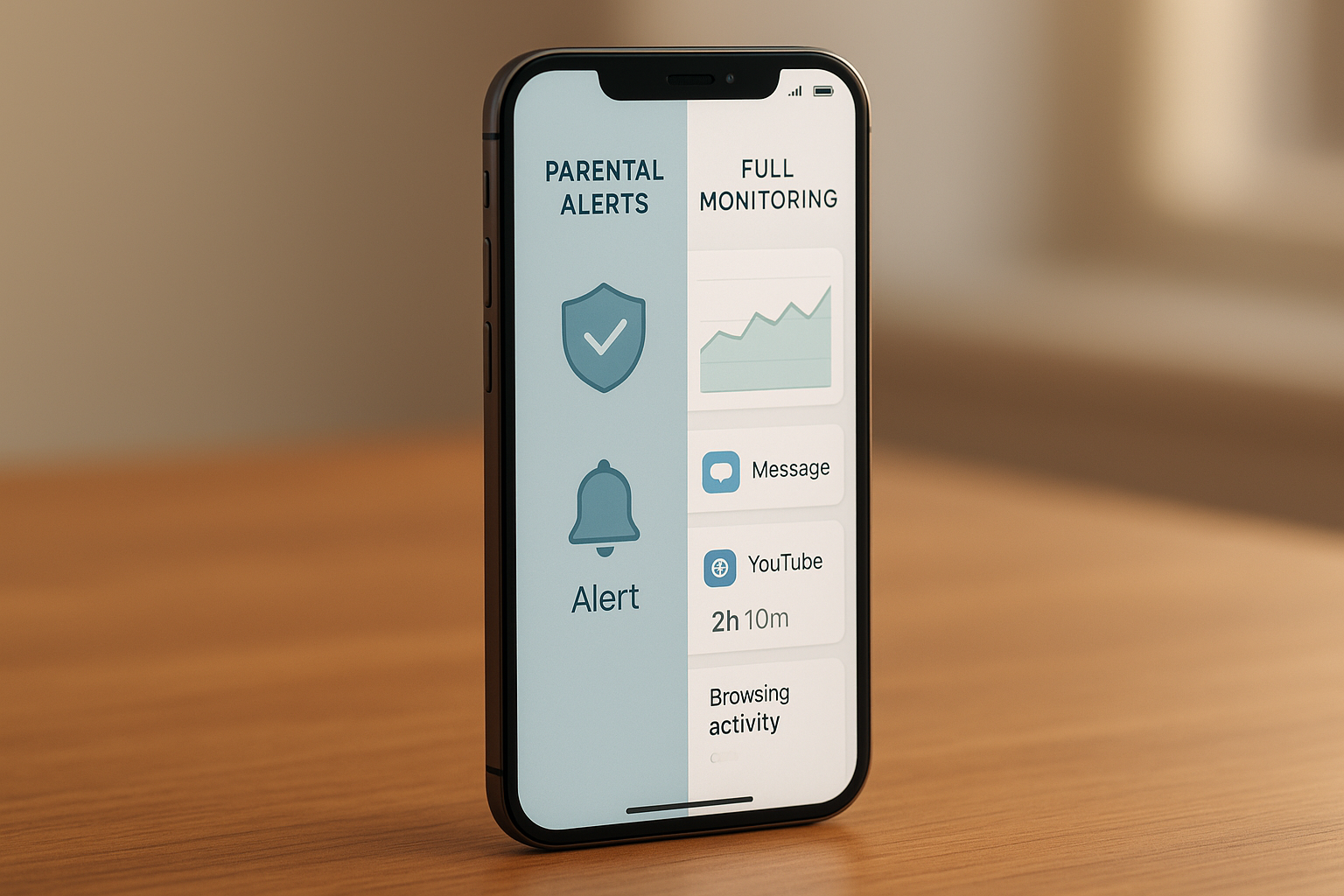
Parental Alerts vs. Full Monitoring: Key Differences
Parents are increasingly turning to digital tools to protect their children online, especially as online grooming and sextortion cases have surged dramatically in recent years. Two popular options are parental alerts and full monitoring systems, each offering distinct approaches to safety and privacy. Here's a quick breakdown:
- Parental Alerts: AI-based systems that notify parents of specific risks (like predatory behavior or cyberbullying) without exposing all conversations. These tools prioritize privacy and are ideal for older kids who need some independence.
- Full Monitoring: Provides complete access to all messages, activity logs, and more, giving parents total visibility. Best suited for younger children or high-risk situations but may strain trust due to its intrusive nature.
Quick Comparison
| Feature | Parental Alerts | Full Monitoring |
|---|---|---|
| Privacy | High (flags only risks) | Low (access to all data) |
| Best For | Teens, older children (13+) | Younger kids, high-risk cases |
| Cost | Lower (one-time fees: $100–$200) | Higher ($27.95–$49.95/month) |
| What Parents See | Specific threats | All digital activity |
| Trust Impact | Maintains trust | Can cause tension |
Both tools address growing online dangers, like the 400% rise in grooming cases since 2020, but the choice depends on your child's age, maturity, and your family’s privacy preferences.
Parental Alerts: How They Work and When to Use Them
How Parental Alerts Function
Parental alert systems rely on real-time AI detection to analyze the content of messages. Unlike basic keyword filters, these systems can understand context, allowing them to differentiate between harmless interactions and actual threats.
These systems continuously monitor direct messages across various platforms, using algorithms to identify patterns linked to predatory behavior, bullying, or other harmful activities. When suspicious content is detected, it’s removed from the child’s view and securely stored for further review.
Take Guardii, for example. This system uses AI to evaluate and contextualize the direct messages children receive on social media. Its smart filtering technology doesn’t just flag keywords - it evaluates the surrounding context to identify genuine risks while ignoring normal conversations. If a potential threat is spotted, parents receive an instant alert, such as:
"Guardii Alert: Potential threat detected. Message from unknown contact contained grooming language."
The system also includes an evidence preservation feature, securely saving flagged content for possible use in law enforcement investigations. This ensures harmful material is blocked before children can see it while maintaining a record of the incident. Such functionality provides a balanced approach, combining protection with thoughtful oversight.
Privacy and Trust Advantages
One of the key strengths of parental alerts is their ability to safeguard privacy. A 2023 Pew Research Center survey found that while 66% of U.S. parents of teens have used parental control tools, only 39% opted for tools that grant full access to their child’s device or accounts [4]. This highlights the need for solutions that protect children without overly intruding on their digital independence.
By focusing only on genuine concerns, these systems limit unnecessary intrusion, fostering trust between parents and children. The AI works quietly in the background, ensuring parents are only notified about serious risks. This approach allows children to maintain their independence while staying protected from significant online dangers.
Additionally, the transparency of these systems - where children understand what triggers an alert - encourages open conversations about online safety and boundaries. According to a 2024 report from Bark, over 85% of alerts sent to parents involved bullying, suicidal thoughts, or predatory contact [4]. This targeted alerting ensures parents are not overwhelmed by notifications about harmless interactions, making the system more effective and manageable.
Best Situations for Parental Alerts
The combination of technical precision and respect for privacy makes parental alerts especially effective in certain family contexts. These systems are ideal for older children and teenagers who are gaining digital independence but still need protection from serious online risks. They work particularly well for families that value open communication and aim to balance trust with safety.
Parental alerts are especially useful as children become more active on social media and messaging apps. Since many grooming cases begin on social platforms and move to private messages, having a monitoring system in place is critical as children engage more online.
These systems act as a safety net during the transition from childhood to adolescence - a time when children may lack the experience to identify manipulative tactics from online predators. The 149% rise in sextortion reports from 2022 to 2023, particularly targeting teenage boys [1], highlights the urgent need for such safeguards.
For parents aiming to gradually reduce direct supervision as their children mature, these alerts provide an ideal solution. They can be adjusted over time, offering less oversight while still ensuring critical protection. This helps children develop digital responsibility while staying shielded from significant threats.
While parental alerts are better suited for older children and teens rather than very young kids or those in high-risk situations, they provide a reliable middle ground for families striving to balance safety with independence.
Full Monitoring: Complete Oversight and When It's Needed
How Full Monitoring Functions
Full monitoring tools provide parents with a detailed view of their child's digital activities. These systems track messages, browsing history, app usage, and online interactions. Through activity logs and dashboards, parents can see everything from the time spent on specific apps to entire conversation histories on messaging platforms. Many tools go further, offering features like GPS tracking, screen recordings, and even keystroke logging to paint a comprehensive picture of a child's behavior online.
Another advantage is extended data storage. This lets parents spot patterns over time, such as gradual changes in communication habits or increased interactions with unfamiliar contacts - things that might slip through the cracks if relying solely on individual alerts.
Some platforms also include human oversight. Trained specialists can evaluate flagged situations and coordinate appropriate responses, helping to separate real emergencies from false alarms. One platform, for example, boasts an average response time of just 29 seconds [3]. These capabilities highlight the effectiveness of full monitoring, but they also bring privacy concerns to the forefront.
Balancing Oversight and Privacy
While full monitoring offers valuable insights for parents, it comes with significant privacy considerations. Having full access to a child's digital communications and interactions can leave children feeling like their independence is being stifled. If not handled carefully, this level of oversight can strain the parent-child relationship.
Overly strict monitoring might even backfire, encouraging kids to find ways to bypass controls or shift their activities to less secure, unsupervised spaces. This could inadvertently increase their exposure to online risks.
The key to avoiding these pitfalls is open communication. Parents should explain the purpose of monitoring, set clear boundaries about what will be reviewed, and involve children in discussions about online safety. By framing monitoring as a teaching tool rather than a form of punishment, parents can help their children develop responsible digital habits. Adjusting the level of oversight as kids demonstrate greater maturity and responsibility can also strike a healthier balance between protection and trust.
When Full Monitoring Makes Sense
Given the privacy challenges, full monitoring is most appropriate in specific situations where comprehensive oversight is crucial. For younger children - especially those under 12 - full monitoring can be a vital tool. At this age, kids often struggle to recognize online risks, such as manipulative behavior or the dangers of sharing personal information, making detailed supervision a necessary safeguard.
It’s also critical in high-risk scenarios, such as cases of cyberbullying, exposure to harmful content, or online predation. In these situations, full monitoring can provide the visibility needed to gather evidence and address serious issues. Similarly, children with special needs or developmental challenges, who may find it harder to interpret social cues, can benefit from continuous oversight regardless of their age.
Full monitoring is also helpful during transitional periods, like when a child starts using a new platform or device. Initially, comprehensive monitoring allows parents to better understand their child’s digital habits. Over time, as the child shows responsible behavior, parents can gradually reduce the level of oversight.
In the U.S., full monitoring systems typically cost $30–$50 per month, compared to one-time fees of $100–$200 for simpler alert-based setups [4]. Because of this, full monitoring is best viewed as a temporary, goal-driven solution. Parents should establish clear criteria for scaling back monitoring as their child matures and gains a better understanding of online safety.
Privacy, Risk Detection, and Trust: Side-by-Side Comparison
Privacy Differences
The contrast between parental alert systems and full monitoring lies in how each handles privacy. Parental alert systems notify parents only when necessary, offering a layer of protection while respecting a child’s personal space. For instance, tools like Guardii use AI to analyze messages and flag only serious concerns, ensuring that minor, everyday interactions remain private.
On the other hand, full monitoring grants parents unrestricted access to their child’s digital world, including messages, browsing history, and app usage. While this approach provides a complete picture, it often comes at the expense of a child’s sense of privacy. Children under full monitoring may feel like their personal boundaries are being crossed, which can make them less likely to share their online experiences voluntarily.
In essence, parental alerts concentrate on critical threats, whereas full monitoring lays bare all digital interactions. This divide also influences how each system identifies and records risks.
Risk Detection and Evidence Collection
The way these systems detect threats and handle evidence reflects their differing approaches to privacy. Full monitoring captures every online interaction, allowing parents to spot subtle warning signs, track long-term behavioral changes, and uncover risks that may not trigger automated alerts. These detailed logs provide a broader view of communication patterns over time.
Parental alert systems, however, are designed to identify high-risk situations in real time using advanced algorithms. While they might miss some nuanced threats, they excel at flagging serious issues like grooming, sextortion, and cyberbullying. AI-powered tools such as Guardii can even detect predatory behavior and harmful content with impressive accuracy, sometimes catching risks that might slip through even with full monitoring.
In summary, full monitoring offers a wealth of data for long-term analysis, while parental alerts focus on immediate dangers and provide targeted evidence tied to specific threats.
Effects on Parent-Child Relationships
When it comes to fostering trust, parental alert systems and full monitoring take very different paths. Alert systems promote open communication by respecting a child’s privacy. When children feel their personal space is acknowledged, they’re more likely to share their online experiences and seek help when needed. This approach also reassures kids that their parents trust their ability to navigate the digital world while being ready to step in during serious situations.
"We believe effective protection doesn't mean invading privacy. Guardii is designed to balance security with respect for your child's development and your parent-child relationship." [1]
In contrast, full monitoring can create tension, especially with older children and teens who value their independence. Constant surveillance may leave them feeling untrusted, which can lead to resentment. Over time, this approach might also encourage dependency on parental oversight, preventing kids from developing the confidence and judgment needed to manage their digital lives independently.
sbb-itb-47c24b3
Parental Alerts vs. Full Monitoring: Quick Reference Table
Key Differences at a Glance
Here’s a quick breakdown to help families compare their options:
| Attribute | Parental Alerts | Full Monitoring |
|---|---|---|
| Privacy Level | High – flags only concerning content | Low – provides access to all activity |
| What Parents See | Only specific threats and risks | Entire digital activity logs |
| Risk Detection | AI-targeted threat identification | Comprehensive scanning of all interactions |
| Evidence Collection | Saves flagged incidents and suspicious content | Archives all monitored activity |
| Trust Impact | Maintains trust by respecting privacy | Can create tension due to constant oversight |
| Best Age Groups | Teens and older children (13+) | Younger children or high-risk cases |
| Response Time | Instant alerts for serious threats | Requires manual review of collected data |
| Monthly Cost Range | Lower or free basic features | $27.95–$49.95 for premium services |
| Setup Complexity | Easy to install and manage | More complex with ongoing data handling |
| Data Storage | Minimal – only saves flagged content | Extensive logs needing significant storage space |
This table highlights the trade-offs to consider when choosing the right tool for your family.
Interestingly, research shows that while 60% of U.S. parents use digital safety tools, only 39% opt for full monitoring[4]. This indicates a preference for the balanced approach that parental alerts provide.
Cost is another deciding factor. Alert-based systems are often more budget-friendly, while full monitoring services typically range between $27.95 and $49.95 per month.
The speed of response is also a key consideration. Alert systems can notify parents almost instantly, with response times as fast as 28 seconds[2]. In contrast, full monitoring requires parents to manually review collected data, which can delay responses.
For families focused on building trust, tools like Guardii strike a balance by flagging serious threats while respecting everyday privacy.
How to Choose the Right Option for Your Family
What to Consider Before Deciding
When deciding on the best digital safety solution for your family, start by thinking about your child's age, maturity, and level of online activity. Younger kids, who might not yet understand online risks, often benefit from full monitoring for comprehensive protection. On the other hand, teens who’ve shown responsible behavior may respond better to alert-based systems, which respect their growing independence while still providing oversight.
It’s also important to evaluate your child’s risk level online. For example, grooming cases have increased by over 400% since 2020, with 8 out of 10 incidents beginning in private messages. If your child spends significant time on messaging platforms or chat rooms - areas considered high-risk - full monitoring might be the better choice. For general social media use, a system that focuses on targeted alerts may be sufficient.
Your family's stance on privacy is another key factor to weigh.
"Kids are tech-savvy, but not threat-savvy. They need guidance, not just gadgets" [1].
Decide whether you’re comfortable with complete oversight or prefer to be alerted only when genuine threats arise. Cost is another consideration. Full monitoring services typically range from $27.95 to $49.95 per month, while alert-based systems are usually more affordable [4]. If you’re protecting multiple children, this can significantly influence your monthly expenses.
As your child grows, revisit these considerations to adjust your approach. This thoughtful evaluation not only helps you choose the right tools but also sets the foundation for open discussions about online safety.
Talking with Your Child and Staying Flexible
Once you’ve considered factors like age, online habits, privacy preferences, and budget, it’s essential to talk openly with your child about digital safety. Use age-appropriate language to explain online risks and why protection is necessary. As Stephen Balkam, CEO of the Family Online Safety Institute, puts it:
"Unfiltered internet is like an unlocked front door. Anyone can walk in" [1].
Whenever possible, involve your child in the decision-making process. Explain how the monitoring system works, what information you’ll have access to, and why it’s being implemented. This transparency can help build trust and reduce the chances of your child trying to bypass the system.
As your child grows, be prepared to adapt. A strategy that works for a 10-year-old may not suit a 16-year-old. Regularly check in to discuss how the system is working and whether changes are needed. As your child demonstrates more responsibility and maturity online, you might transition from full monitoring to alert-based systems - or even phase out monitoring entirely.
Starting with a more protective approach and gradually scaling back as trust builds is a practical strategy. Tools like Guardii can support this process by offering AI-driven protection that balances safety and privacy. This approach lets you maintain oversight without being overly intrusive, ensuring your strategy evolves alongside your child’s development while keeping the balance between protection and respect for their privacy.
Best Parental Control Apps for 2025 (Tested with Real Families: UPDATED WINNER)
FAQs
How do parental alerts protect children while respecting their privacy?
Parental alert systems such as Guardii aim to protect children by keeping an eye on direct messages for harmful content, all while respecting their privacy. Using AI, these systems can spot and block suspicious activity, offering a layer of safety without requiring parents to dig into every detail of their child’s conversations.
Guardii takes it a step further by filtering out harmful content so the child never sees it. If needed, the flagged material is securely stored for review. This thoughtful approach helps build trust between parents and children by focusing on protection without overstepping boundaries.
When is full monitoring more useful than parental alerts?
Full monitoring shines in scenarios where a more thorough approach to keeping kids safe online is necessary. For instance, if your child spends a lot of time on direct messaging platforms or engages in online interactions that might expose them to harmful content or unsafe individuals, full monitoring offers a deeper level of insight and proactive protection.
Unlike parental alerts, which only notify you about specific flagged activities, full monitoring works continuously, tracking and analyzing interactions in real time. This approach is particularly helpful for parents who want to prioritize their child’s safety without relying solely on reactive measures. By providing a more comprehensive view, full monitoring can spot patterns of risky behavior early, striking a thoughtful balance between protecting your child and respecting their privacy.
How can full monitoring affect the trust between parents and children over time?
Over time, keeping constant tabs on kids can strain the trust between parents and their children. While it gives parents a clear view of what their child is up to, it can also leave kids feeling like their personal space is being invaded. This can lead to frustration, resentment, or even encourage them to hide things.
To build a stronger bond, parents should aim to strike a balance between keeping their child safe and respecting their growing need for independence. Prioritizing open conversations and fostering mutual trust can go a long way in maintaining a healthy relationship.