
Parent Guide to AI Child Safety in Private Messages
Most child safety risks online start in private messages, not public posts. If I’m turning on an AI safety tool for my child, I need to look for four things right away: behavior-based detection, clear alert levels, privacy limits, and a calm response plan.
Here’s the short version:
- Public posts aren’t the main problem. Grooming, sextortion, and coercion often begin in DMs, game chat, or disappearing messages.
- Single-word filters miss too much. Better tools look for patterns like secrecy, age probing, app-switch requests, gift offers, image requests, and threats.
- Alerts are not proof. I should treat them as a prompt to check in, not a reason to punish.
- Privacy still matters. Before I switch anything on, I should ask what data is stored, who can see it, whether raw messages are kept, and how long records stay on file.
- Serious threats need action fast. If there’s blackmail or image coercion, I should save evidence, block the contact, report the account, and file a report with the NCMEC CyberTipline.
One stat stands out: 30% of sextortion victims get demands within 24 hours of first contact. That’s why message-pattern detection matters. It helps me spot a chat that is shifting from normal talk to pressure and control.
A simple way to think about it is this:
| What I should check | What matters |
|---|---|
| How the tool detects risk | It should read patterns over time, not just bad words |
| What the alert shows | It should give a plain-English summary and risk level |
| How I respond | I should start with a calm conversation, not blame |
| How privacy is handled | I should know what is stored and who has access |
If I want to protect my child without reading every message, this is the balance I’m aiming for: early warning, limited data access, and trust at home.
How AI Child Safety Tools Monitor Private Messages
AI safety tools don’t just look for single bad words. They scan message patterns and flag chats that start moving toward risk. That applies to direct messages across apps. Some tools also scan images shared in chats for sexualized content, bullying, self-harm, or violence. [7][6]
What they’re looking for is risk patterns, not personality. That move from isolated words to patterns is what makes the next layer of detection work.
Behavior-Pattern AI vs. Basic Keyword Filters
A keyword filter works like a checklist. If a message includes a word from a preset list, it gets flagged.
Behavior-pattern AI works differently. It looks at the flow of a conversation over time: Is someone pushing for secrecy? Is the tone getting more intense? Is the person trying to move the chat to another app? That’s why behavior-based systems can catch grooming earlier than simple filters.
| Feature | Basic Keyword Filters | Behavior-Pattern AI |
|---|---|---|
| How it works | Flags isolated pre-defined words | Analyzes conversational escalation over time |
| Reads context | Low - misses slang or code-switching | High - understands how a conversation evolves |
| Easy to evade | Yes - changing spelling or slang bypasses it | Harder - tracks behavioral sequences, not specific words |
Those patterns then turn into alerts parents can use without digging through every message.
How Risk Scores and Plain-English Alerts Work
When a behavior-pattern system spots something concerning, it creates a severity level and a plain-English summary of what it found. For instance, a critical alert might point to a sustained pattern of secrecy requests, pressure for explicit images, and an effort to move the conversation to another app.
"Detection reports the shape of a conversation - sustained targeting, escalation, coercion - not its contents. You are told what is happening and how serious it is. You are not handed a feed of what was said." [1]
That gives parents enough information to step in, while balancing child safety and privacy.
A Real Example of Private-Message Behavioral Detection
One example is Guardii, an AI safety platform built to detect predatory and abusive behavior inside private messages. Instead of scanning for banned words, it tracks escalation patterns, including requests for personal details, offers, secrecy, and threats. [1]
That kind of signal is useful because it can help parents act early without reading every line of a child’s chat history.
From there, the next step is figuring out which behavior signals matter most.
sbb-itb-47c24b3
The Behavior Signals AI Tools Track in Grooming and Sextortion
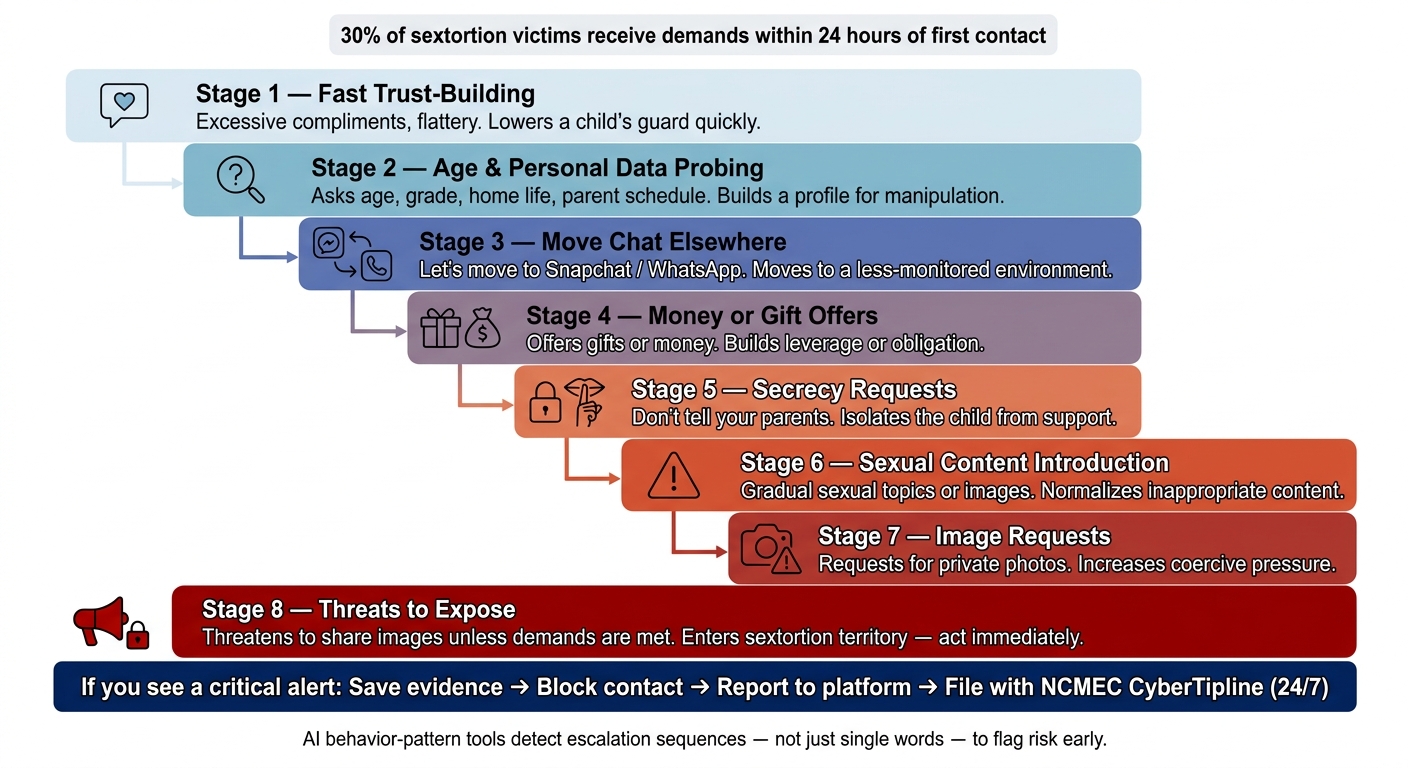
8 Grooming Stages AI Tools Detect in Private Messages
A chat doesn't turn dangerous because of one message. It turns dangerous because of the sequence: one message leads to another, the tone shifts, and pressure starts to build. That's what AI tools watch for when they try to spot grooming and sextortion early.
Parents need that map. If an alert goes off, it should show which stage of escalation the chat has reached and why it matters.
Common Grooming Patterns in Private Chats
Each pattern below gives parents a plain reason an alert fired.
| Stage | What It Looks Like | Why It Matters |
|---|---|---|
| Fast trust-building | Excessive compliments, "you're so mature for your age" | Lowers a child's guard quickly |
| Age and personal-data probing | Asks age, grade, home life, or parent schedule | Gauges vulnerability and builds a profile for manipulation |
| Move chat elsewhere | "Let's move this to Snapchat / WhatsApp" | Moves to a less-monitored environment |
| Money or gift offers | Money or gift offers | Builds leverage or a sense of obligation |
| Secrecy requests | "Don't tell your parents about this" | Isolates the child from support |
| Sexual content | Gradual introduction of sexual topics or images | Normalizes inappropriate content |
| Image requests | Requests for private photos, often framed as "just between us" | Increases coercive pressure |
| Threats to expose | Threats to share images unless demands are met | Moves into sextortion territory |
Speed matters too. One cited finding says 30% of sextortion victims receive demands within 24 hours of first contact. [5]
How AI Tells Normal Teen Talk Apart from Concerning Behavior
Teenagers say plenty of things online that can sound bad if you pull them out of context. A good AI system takes that into account. Instead of reacting to one risky phrase or a piece of slang, it looks for repetition, pressure, and escalation over time.
For example, one question about age usually means nothing. But an age probe followed by gift offers, a request to switch platforms, and demands for secrecy starts to form a pattern. That's when the risk becomes easier to spot.
More advanced systems also look for signs of control or coercion. That can include hints that one person is much older, keeps pushing, or is trying to corner the other person. Advanced systems are trained to recognize grooming escalation, sextortion, and AI-generated abuse patterns. [1] Similar technology is also used to detect live-streaming exploitation in real-time. Most messages are harmless, but the risky pattern stands out. [2]
Useful alerts should turn that pattern into plain English so parents can see what changed and why the chat needs attention.
How Parents Should Use Alerts to Support, Not Punish
When a tool flags a risk, what happens next matters just as much as the alert itself.
An alert is an early warning, not proof. Parents should use alerts to check in, not punish. The goal is to help families start better conversations early. If a child feels that every alert will end in blame or trouble, they’re more likely to hide problems later.
What a Useful Alert Should Tell a Parent
A useful alert should explain the behavior, not just label the risk. It should show a risk level - low, medium, or critical - along with a short plain-English summary of what was found and why it was flagged. It should not include a full transcript of the conversation.
Here’s a simple way to match each alert level with a parent response:
| Alert Level | Pattern Detected | Parent Response |
|---|---|---|
| Low | Suspicious new contact | Ask casually if they know the person |
| Medium | Age probing or boundary testing | Start a conversation about digital boundaries and why people ask for ages |
| Critical | Grooming, coercion, or platform migration | Save the messages and evidence, block the contact, report to the platform and authorities |
How to Respond in a Way That Keeps Trust Intact
Start with a calm check-in, not an interrogation. If your child has already said something feels off, thank them for speaking up. That small step can make a big difference.
If they haven’t mentioned it, bring it up gently. Use behavior-based language that focuses on what the other person is doing, not on your child’s choices. For example: “The tool noticed someone pushing to move apps. Let’s look at that together.” That keeps the focus where it belongs - on the threat, not on blame.
Speed matters here. So does tone. Fast, calm follow-up gives parents a better shot at helping without breaking trust.
When to Report to Authorities and Seek Outside Support
If an alert points to threat, blackmail, or coercion, the response needs to shift from conversation to evidence preservation and reporting. If a serious alert shows signs of blackmail, explicit-image coercion, or grooming sequences, save the messages and evidence first. Then block the contact and report it. Reporting can protect the child and keep paths open for help.
Report to the platform, the NCMEC CyberTipline, and local law enforcement [6][4]. The CyberTipline accepts reports 24 hours a day [6].
"Preserve all communications and evidence of harmful interactions. Secondly, report immediately to the platform involved and your local authorities or cyber safety bodies." - Guardii.ai [6]
Privacy, Family Rules, and Making the Final Call
Privacy Questions to Ask Before Turning Monitoring On
Before you switch on any monitoring tool, pause and ask a few plain questions. You want to know what the tool keeps, who can see it, and what happens to that data later.
Start with the basics. Does the tool store raw messages, or does it keep only risk summaries? Can company staff access private chats? Is any of that data reused for ads or model training?
Then go a step further. Ask how long the data stays on file, whether human review is ever part of the process, whether the tool uses official platform APIs, and whether it creates a tamper-evident report for serious cases. Those answers tell you a lot. Some tools are built to limit exposure. Others collect far more than most families would want.
| Question to Ask | What a Privacy-Respecting Answer Looks Like |
|---|---|
| What data is stored? | Risk summaries and behavioral patterns, not raw transcripts [1] |
| Can company staff read messages? | No routine human review of raw messages during scanning [3] |
| Is data used to train models? | Clear opt-out or no-repurposing policy [1] |
| How does it connect to platforms? | Uses official platform connections only [2][3] |
| What happens if a threat is serious? | Tamper-evident log that can support a report [3] |
How to Create a Digital Trust Agreement at Home
Once you understand how the tool handles data, set the rules at home before monitoring starts. Don’t make it a surprise. Sit down with your child and explain what the tool is looking for - grooming patterns, escalation signals, and coercion - and what it is not doing. It is not there to show you every message they send.
Keep the agreement simple and clear. Cover:
- when monitoring is on
- what triggers an alert
- how you will respond
- when oversight will loosen
That last part matters. Oversight shouldn’t stay the same forever. Match the level to your child’s age and maturity. Sensitivity should line up with both, using low, medium, or high settings as needed [7].
Conclusion: What Parents Should Take Away
Private messages are often where risk speeds up, so behavior-based monitoring matters most in that space. Basic keyword filters miss how predators tend to work in practice. Behavioral AI looks at escalation patterns, not just single words. Alerts do their best job when they start a conversation instead of shutting one down. And the privacy choices - what gets monitored, what gets stored, and who gets notified - should be decided openly with your child before any tool is turned on.
FAQs
How accurate are AI message safety alerts?
AI message safety alerts tend to be more accurate than simple keyword filters because they look at behavior patterns and context in real time, not just single words.
Some systems, including Guardii, report 99.1% precision by spotting grooming or escalation patterns and generating explainable risk scores. That means alerts can stay focused on higher-risk situations while cutting down on flags for harmless conversations.
What age should parents start using these tools?
There’s no stated specific age to start AI child-safety tools for private messages.
That said, one Guardii-related source notes that harm can happen before age 12. So in practice, it may make more sense to start before 12 and stay watchful during the early teen years, instead of waiting.
How can I monitor messages without hurting trust?
Use pattern-based safety tools that cut down the need to watch every message yourself. Instead of checking chats one by one, these tools run in the background and spot harmful behavior like grooming or sextortion as it happens.
They notify you only when there’s a real risk. That way, talks with your child can center on support and confidence, not suspicion.