
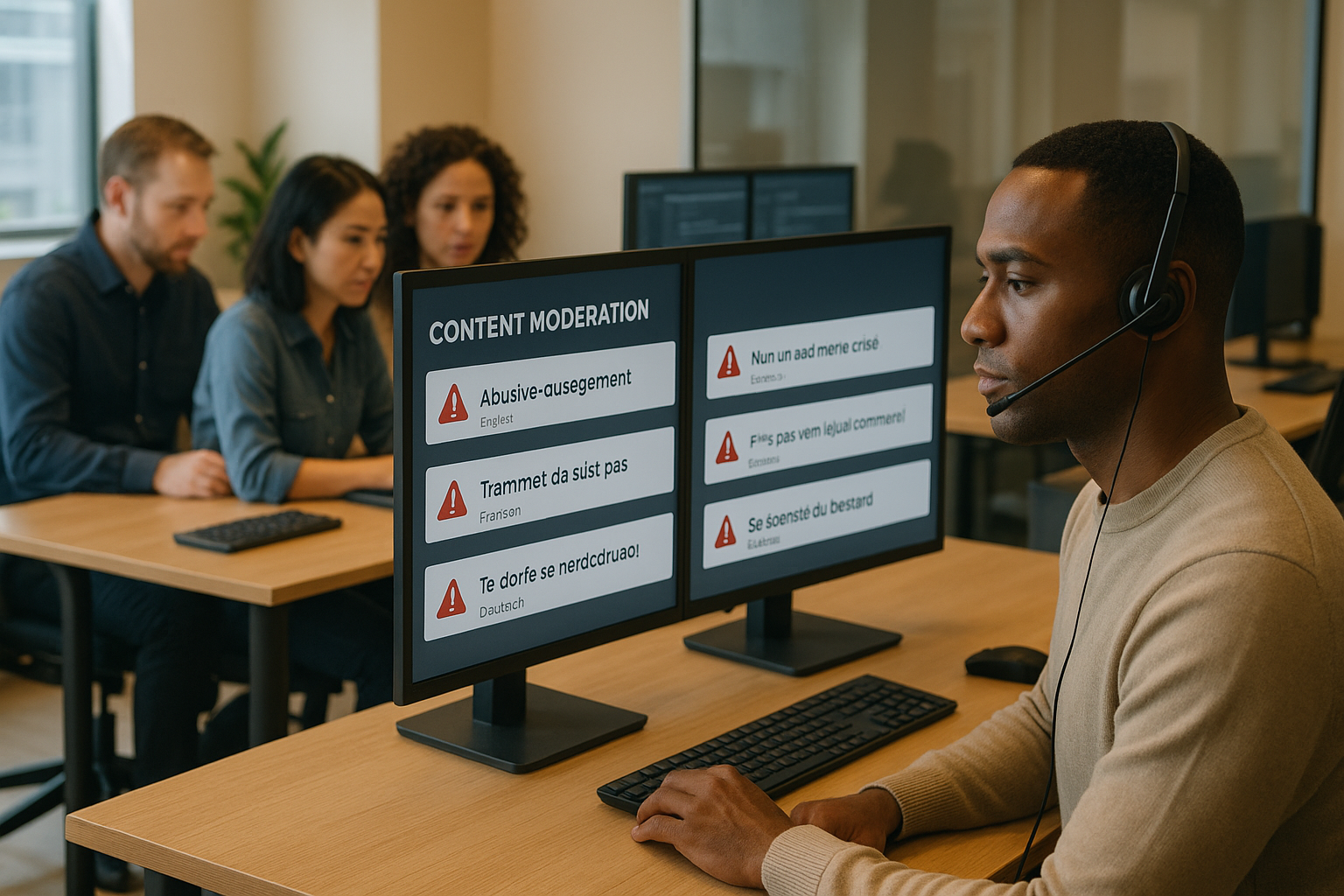
How Multilingual AI Protects Against Online Harassment
Online harassment is a growing issue that affects public figures, creators, and athletes worldwide. The problem becomes harder to manage when abuse is delivered in multiple languages, using slang, transliterations, or cultural references that evade detection by English-only moderation tools. Current systems fail to address this complexity, leaving users vulnerable to harmful messages, threats, and coordinated attacks.
Key takeaways:
- Multilingual AI tools like Guardii detect harassment in over 40 languages, auto-hide toxic comments, flag high-risk DMs, and provide evidence packs for legal and safety teams.
- These systems analyze context, tone, and patterns to identify abuse, even when disguised through code-switching or slang.
- Benefits include: protecting athletes and creators from harmful content, safeguarding brand reputation during events, and reducing manual moderation costs.
- Guardii complies with Meta's moderation rules, ensuring actions like hiding or flagging content meet platform standards.
This shift from single-language systems to multilingual AI offers better protection for users, faster responses to threats, and improved outcomes for organizations managing global audiences.
Why Traditional Moderation Fails Against Multilingual Harassment
Harassment Hidden in Multiple Languages
Traditional moderation systems are struggling to keep up with the creative ways abusers hide their harassment across languages. By mixing languages in a single comment, using slang that doesn’t show up in standard dictionaries, or transliterating offensive words into different scripts, they manage to slip through the cracks. For instance, a Spanish insult might easily bypass an English-only filter.
Transliteration is a particularly sneaky tactic. In languages like Arabic, Russian, and Hindi, users often write abusive terms using Latin characters, making it even harder for keyword-based filters - most of which are trained on English - to catch them.
This problem disproportionately affects groups like athletes, women creators, and journalists who engage with global audiences. Imagine a female journalist covering international sports: she might receive sexualized comments in Spanish, Arabic, and Portuguese, while the English-language moderation system catches none of it. The harassment escalates from crude remarks to outright threats, unchecked because the system simply doesn’t understand the linguistic nuances. This highlights a glaring issue: moderation systems that rely on just one language are completely inadequate for today’s global digital landscape.
Single-Language Moderation Cannot Scale
English-only moderation tools leave massive blind spots for anyone with a multilingual audience. This approach is especially ineffective in global communities, where harmful messages in non-English languages often go unnoticed.
Relying on manual moderation isn’t a practical solution either - it just shifts the burden. Hiring enough moderators to cover over 40 languages is both costly and unrealistic. Even a global sports club with fans spread across Europe, Latin America, Asia, and the Middle East would struggle to keep up with the sheer volume of comments and messages during a major event. The result? Delayed responses or missed abuse altogether. On top of that, human moderators face the emotional toll of dealing with abusive content daily, which limits their capacity to handle the workload effectively.
Industry tests have already shown that single-language moderation tools fall short in protecting non–English-speaking users, leaving them vulnerable to unchecked harassment.
Consequences for Safety, Wellbeing, and Reputation
When multilingual harassment goes unchallenged, the consequences are severe and immediate. Athletes and women creators often face violent threats, sexual harassment, doxxing, and even coordinated attacks that extend beyond the digital realm. For female journalists and influencers, this abuse frequently includes explicit threats of rape and violence, leading to anxiety, depression, and sometimes the decision to deactivate their accounts just to escape the relentless onslaught.
The mental health impact is even more overwhelming when the abuse comes in multiple languages. Victims often find their comment sections flooded with hateful messages they may not fully understand, making it harder to report or address the issue. This sense of helplessness amplifies the emotional toll.
The damage doesn’t stop with individuals - it spreads to brands and sponsors. For example, during high-profile events like tournaments or product launches, a surge in multilingual abuse can lead to screenshots circulating on social media, painting an organization as negligent or unsafe. In the U.S., where brand safety and corporate responsibility are closely monitored, this kind of reputational damage can result in lost sponsorships and partnerships.
The gaps in moderation also disproportionately harm non–English-speaking fans, minors, and marginalized groups. Low-resource languages often lack robust datasets and tools, leaving these communities especially vulnerable. Additionally, response times for comments in these languages can lag behind English, sometimes taking hours or even days to address. This delay is particularly dangerous during live events or viral moments, when abusive content can spread quickly across languages, putting user safety at even greater risk.
These challenges underline the urgent need for AI systems capable of navigating multilingual environments. Traditional moderation tools were designed for a simpler, less interconnected digital world. They fail to account for the complexity of today’s global audiences, leaving the people they’re supposed to protect exposed to harm. And right now, that failure is costing individuals and brands alike.
How Multilingual AI Stops Online Harassment
Language Models That Understand Context
Multilingual AI leverages transformer-based models to interpret harassment across various languages, even when it's disguised or mixed with other languages. These models go beyond surface-level analysis by examining context - like conversation history, tone, and targeting patterns - to differentiate between harmful language and reclaimed terms.
One of the standout features of these models is their ability to handle code-mixed content. Unlike traditional single-language filters, which often miss subtle nuances, multilingual AI trained on diverse datasets can grasp the meaning of phrases at both sentence and conversation levels. This makes them particularly effective at identifying indirect harassment techniques, such as sarcasm, dog whistles, euphemisms, or creative spellings like "h8" instead of "hate."
Another vital aspect is their sensitivity to local contexts. Insults tied to specific regions, politics, sports, or religious matters require specialized training data annotated by native speakers and experts familiar with local norms. These systems also track behavioral patterns, such as repeated targeting or coordinated harassment campaigns, ensuring persistent issues are flagged even when they might otherwise go unnoticed.
That said, challenges remain. Research highlights that while AI models reach about 82% accuracy in English-only settings, this drops to around 68% in multilingual scenarios due to complexities like slang, code-switching, and cultural subtleties [1]. To improve, these systems rely on continuous learning and human oversight to adapt and reduce errors.
This nuanced understanding allows for quick and effective interventions in digital spaces.
Real-Time Moderation for Comments and DMs
Building on their contextual analysis abilities, multilingual AI enables real-time moderation to minimize harm. The quicker abusive content is addressed, the less damage it can cause to individuals, communities, or brands.
Here’s how it works: When a comment or direct message (DM) is posted, it’s instantly sent to a moderation service via an API or webhook. Within milliseconds, an optimized classifier evaluates the content and assigns a harassment score with detailed labels. Based on preset thresholds, the system can take immediate action - hiding high-risk content from public view automatically while flagging borderline cases for human review.
For direct messages, the stakes are even higher. Multilingual AI examines full conversations to detect severe issues like sexual harassment, grooming attempts, or violent threats. Studies show that combining indicators such as sexual content, age-related clues, secrecy, and power dynamics can effectively identify predatory behavior across languages. If a message crosses a risk threshold, it’s flagged, blocked, or escalated to safety teams, ensuring sensitive cases - especially those involving minors or public figures - are handled promptly. Real-time alerts sent through tools like Slack, Microsoft Teams, or email ensure immediate intervention.
Guardii's Multilingual Protection Features
Guardii takes these advanced capabilities and integrates them into a seamless workflow, specifically designed for high-risk online environments. Supporting over 40 languages, the platform uses AI that understands both context and cultural nuances to detect harassment often missed by single-language tools.
One of its key features is Meta-compliant auto-hiding of abusive comments. When Guardii's AI identifies hate speech, threats, or other harmful content, it automatically removes the comments in real time using Instagram's official moderation hooks. This ensures that during high-traffic moments - like a major sports event - comment sections remain clean and secure, protecting both individuals and brand reputations.
Guardii also prioritizes serious threats in direct messages, such as explicit harassment or violent language. Its AI analyzes conversation patterns to spot grooming behaviors, coercive language, and other high-risk indicators. Dangerous messages are routed to Priority queues for immediate action by safety teams, while borderline cases are sent to Quarantine queues for further review. This process minimizes the exposure of athletes, creators, and other users to harmful content.
Additionally, Guardii generates detailed evidence packs, complete with timestamps, message copies, and risk labels. These can be used for internal investigations, law enforcement referrals, or legal actions. The platform also maintains watchlists to track repeat offenders, aiding in the detection of coordinated harassment campaigns or serial abusers.
To meet U.S. standards for corporate responsibility, Guardii offers Meta-compliant auto-hiding, secure API tokens, and transparent audit logs, empowering organizations to act swiftly and make informed decisions about staffing and safety measures.
Best Practices for Deploying Multilingual AI
Reducing False Positives and Negatives
Striking the right balance between catching actual abuse and avoiding false alarms is a delicate process that requires fine-tuning and ongoing oversight. Studies indicate that while accuracy in single-language settings can exceed 80%, it often drops to around 68% in multilingual environments.[1] This gap highlights the need for organizations to carefully configure and monitor their systems.
One effective strategy involves adjusting thresholds for each language. For example, a confidence score of 0.7 might work well for identifying harassment in English but could be less reliable in languages with fewer training examples. Teams should calibrate these thresholds individually for each language through validation testing. Additionally, monitoring how often human moderators overturn AI decisions can reveal areas where adjustments are needed.
A layered review process combines automated detection with human oversight for better results. High-confidence cases (e.g., scores above 0.85) can be automatically hidden to shield users from clear abuse. Medium-confidence cases (0.4 to 0.7) should be flagged for human review before action is taken, while low-confidence cases might pass through but remain logged for analysis. This approach creates a feedback loop that helps refine the AI over time.
Regular evaluation is key. Organizations should maintain labeled test sets that include challenging examples - like sarcasm, slang, and code-switching - and assess metrics such as precision, recall, and F1 scores for each language and abuse type (e.g., hate speech, threats, or harassment). A/B testing moderation rules can also help teams understand how changes affect user safety, experience, and moderator workload, allowing for data-driven adjustments.
In a survey of 150 users, 41% expressed concerns about false positives - legitimate content being wrongly flagged - while 56% preferred that AI work alongside human moderators rather than operating independently.[1] This feedback underscores the importance of human-review queues, especially for high-profile accounts like journalists, creators, or athletes, where mistakes can have significant consequences. Allowing human moderators to confirm or override AI decisions helps reduce errors over time and aligns with broader moderation strategies.
Handling Cultural and Linguistic Differences
For multilingual AI to succeed, it must not only detect harmful content but also respect the diversity of language and culture. Language carries cultural nuances that vary widely - what’s offensive in one culture might be harmless banter in another. Similarly, reclaimed terms used within a community can appear as slurs to outsiders. Without accounting for such differences, AI risks misclassifying content and causing harm.
Collaborating with native speakers, linguists, and cultural experts is essential for creating localized guidelines and adaptable lexicons. These experts can help identify coded language and distinguish between genuinely harmful content and context-dependent speech. Research shows that models informed by psychological insights are better at understanding the nuances of cyberbullying, making interventions more effective for users and safety teams.[2]
While building language- and region-specific lexicons is important, it’s not enough. Slang evolves quickly, abusers invent coded terms to bypass filters, and transliteration (writing one language using another’s script) complicates detection. Pairing lexicons with contextual models that analyze conversation history, tone, and targeting patterns can help systems determine whether a phrase is affectionate or aggressive. Adapting filters to these nuances ensures more accurate moderation.
Bias in training data remains a significant challenge. Studies have shown that datasets often over-represent certain dialects as "toxic" or under-represent marginalized voices, leading to skewed outcomes.[2][3] Regular fairness audits can help identify and address these biases, ensuring the system performs equitably across demographics, languages, and cultural groups.
Transparency is critical for building trust. Organizations should provide localized user policies that explain what constitutes harassment in each language and offer a clear appeals process. Allowing users to dispute moderation decisions not only corrects errors but also generates valuable data for improving the AI. Techniques like few-shot learning enable systems to adapt quickly to new slang or coded language with minimal additional training data, which is especially important for underrepresented languages.[3][7]
Privacy, Security, and Compliance Requirements
Beyond operational best practices, deploying multilingual AI requires strict adherence to privacy and compliance standards. These systems often handle sensitive, personal content, making privacy and security non-negotiable - especially in the U.S., where platform policies and child-safety regulations are well-defined.
Data minimization should guide every design decision. Only store what’s absolutely necessary, such as flagged content, timestamps, risk labels, and user identifiers for investigations. Use encryption and pseudonymization to protect this data, and restrict access to authorized teams through role-based controls. For private communications like direct messages, avoid unnecessary data export and ensure encrypted storage.
Retention policies must also be clearly defined. Once an incident is resolved or the required audit period ends, data should be deleted or aggregated into anonymized statistics. For severe threats - like violent language or coordinated harassment - evidence should be preserved with a clear chain of custody for potential legal action. However, routine moderation logs don’t require indefinite storage.
Compliance with platform policies is essential. For example, Meta’s developer guidelines outline permissible actions, such as auto-hiding comments, while prohibiting actions like deleting content without user consent. Tools like Guardii demonstrate how to align with these rules by emphasizing secure API tokens, transparent audit logs, and Meta-compliant auto-hiding features. Organizations should review platform policies regularly, as they are subject to updates.
For U.S.-based deployments, aligning with digital safety and child-protection regulations is crucial. Systems designed to protect minors should incorporate child-centered design that balances effective safeguards with respect for privacy and autonomy. Guardii’s approach to family safety reflects this balance:
We believe effective protection doesn't mean invading privacy. Guardii is designed to balance security with respect for your child's development and your parent-child relationship.[6]
This philosophy should guide the design of monitoring dashboards, alerts, and reporting tools.
Regular security and privacy audits are essential for maintaining confidence. Conduct penetration tests, review access logs, and engage independent auditors to assess model performance across demographics and languages. Publishing high-level findings demonstrates accountability and helps identify potential blind spots.
Configurable risk settings allow organizations to tailor protection to their specific needs. For instance, a youth sports club might require stricter filters than a media outlet covering sensitive topics. Features like priority queues for high-profile accounts, workflows for borderline content, and escalation paths for serious threats should respect privacy while enabling rapid responses. When data minimization, secure handling, platform compliance, and transparency come together, multilingual AI can protect users without compromising their rights.
sbb-itb-47c24b3
AI Content Moderation with Google's Ninny Wan
Measured Results: Safety and Brand Protection Outcomes
When organizations use multilingual AI to tackle online harassment, the results are clear: safer environments, stronger brand protection, and more efficient operations. These benefits impact everyone involved - athletes enduring constant abuse, sponsors investing heavily in campaigns, and teams managing global audiences on tight budgets. The ripple effect? Better experiences for both individual users and brand partnerships.
Protecting Athlete and Creator Wellbeing
One of the standout advantages of multilingual AI moderation is its ability to limit exposure to harmful content for athletes, creators, and their followers. A 2025 study on AI tools for online harassment found that 72% of 150 respondents reported reduced exposure to harmful content. For instance, major sports leagues now auto-hide up to 25,000 abusive comments per match week across 15 languages[1]. Without this technology, much of the abuse - especially in languages moderators don’t speak - would remain visible for far too long.
Quick action is essential for mental health. The UN has highlighted a rise in digital violence against women, warning that online harassment often escalates into offline stalking or violence[5]. Health experts also link online abuse to serious psychological harm, including anxiety, depression, and trauma[4]. This makes removing harmful content as quickly as possible a top priority.
The impact on engagement is equally telling. When harassment spikes, creators often pull back - posting less, canceling live streams, and avoiding interactions with fans. With effective moderation in place, many regain confidence, posting more often, hosting longer Q&A sessions, and reconnecting with their audiences. For younger fans, who are particularly vulnerable, AI tools that catch threats or inappropriate messages in DMs across multiple languages create a safer, more welcoming community.
Protecting Brand and Sponsor Reputation
Sponsors pour substantial resources into athletes, teams, and events, expecting these partnerships to reflect positively on their brand. However, unmoderated hate speech, misogyny, or violent threats under sponsored posts - especially in less familiar languages - can harm their reputation. Worse, toxic comments on social platforms can make sponsors appear indifferent to abuse.
Multilingual AI addresses this by detecting and removing abusive content in real time. This swift action not only eases the burden on human moderators but also creates a cleaner, more positive environment. Many organizations aim to remove 95% of toxic comments within 5 to 10 seconds across all supported languages, cutting off the chance for harmful content to spread.
During high-profile moments like playoff games or product launches, multilingual AI ensures that abusive comments in languages such as Portuguese, French, or Korean don’t linger while moderators focus on English. This broad coverage is essential for protecting brand-related posts from reputational risks.
Sponsors value this proactive approach. Rapid removal of abusive content safeguards their image and minimizes negative public feedback. Many brands cite strong moderation practices and a demonstrated commitment to user safety as key reasons for renewing partnerships, particularly in global campaigns where multilingual moderation is critical.
This strategy reflects advanced practices in multilingual AI - combining quick removal, detailed documentation, and proper escalation. Beyond reputation management, these measures also lead to substantial operational efficiencies.
Efficiency Gains and Cost Savings
In addition to improving safety and reputation, multilingual AI significantly streamlines moderation efforts. Manual moderation is both expensive and time-consuming, especially during major events when comment volumes skyrocket. AI tools reduce this burden by automatically filtering out abusive content, allowing human moderators to focus on complex issues and strategic tasks[1][2].
Organizations can measure these improvements by comparing moderation workloads before and after AI implementation - tracking metrics like the number of comments processed, total hours spent, and cost per 1,000 items reviewed. For example, one sports club reduced its full-time moderation staff by automating the removal of clear-cut abusive content. AI handled the initial triage, leaving only borderline cases and appeals for human review. This shift saved time and cut costs, freeing up resources for tasks like policy updates, staff training, or fairness audits.
AI also simplifies evidence collection and incident management. When harassment campaigns arise, systems that generate detailed logs and evidence packs save legal and safety teams valuable time. These curated dossiers, complete with timestamps, risk labels, and user details, streamline investigations - an especially critical feature for high-profile accounts where delays can have serious repercussions.
Conclusion
Online harassment knows no borders. Abusers often switch between languages, using slang, coded expressions, and even emojis to sidestep detection. For U.S.-based athletes, creators, journalists, and their teams managing diverse global audiences, relying on single-language moderation or basic keyword filters leaves critical blind spots. Research highlights that multilingual moderation tools often lag behind their English-only counterparts, creating gaps that lead to real harm: emotional distress, diminished performance, tarnished reputations, and the risk of losing sponsorships when abusive content remains visible for too long[1].
This is where multilingual AI steps in as a game-changer. These systems can process massive amounts of content in real time across 40+ languages, identifying insults, threats, and sexual harassment - even when veiled in indirect language or scattered across multiple messages. Unlike static keyword filters, modern AI uses context-aware natural language processing to grasp tone, intent, and nuanced meanings. Tools like Guardii automatically hide harmful content and flag high-risk messages, offering safety teams features like Priority and Quarantine queues, evidence packs, and audit logs to support mental health staff, legal teams, and law enforcement.
However, AI can’t do it all. Research confirms that combining AI with human oversight significantly improves protection[1]. The most effective systems pair AI’s speed and scale with trained human judgment to refine models, account for local language variations, and manage false positives and negatives. Clear escalation procedures for credible threats are essential, as is adherence to privacy, security, and platform guidelines. This partnership between technology and human expertise is the cornerstone of robust online safety.
When used responsibly, multilingual AI delivers tangible results: safer digital spaces, stronger brand protection, and operational efficiency that allows teams to focus on proactive engagement. For organizations navigating high-profile online environments, multilingual AI isn’t just a tool - it’s an essential layer of protection, shifting the focus from reactive damage control to continuous, proactive safety. This ensures athletes, creators, and their communities can thrive online with confidence and security.
FAQs
How does multilingual AI like Guardii detect harassment accurately in less common languages or dialects?
Guardii employs cutting-edge AI models to interpret and analyze messages in over 40 languages, including lesser-known ones and regional dialects. By utilizing natural language processing (NLP) alongside an understanding of linguistic and cultural nuances, it can accurately detect harmful content such as harassment or threats.
The system is designed to evolve, learning from a wide range of linguistic data to enhance its detection capabilities and reduce mistakes. This ensures dependable moderation that adjusts to the unique characteristics of different languages, contributing to a safer online space for users everywhere.
What challenges do traditional moderation systems face in detecting online harassment across multiple languages?
Traditional moderation systems face significant hurdles when it comes to tackling multilingual online harassment. One major issue is their limited language support, which often leaves harmful content in less common or regional languages undetected. Another challenge lies in the complexity of context and cultural nuances - a phrase that might seem harmless in one language could carry an entirely different, offensive meaning in another. On top of that, many systems depend on static keyword lists, which simply can’t keep up with the ever-changing landscape of slang, idioms, and coded language that people use to evade detection.
AI-powered tools like Guardii.ai are stepping up to solve these problems. By using advanced language models, they can grasp context and intent across more than 40 languages. This allows for a smarter, more adaptable way to identify and handle toxic content in diverse online spaces.
How does human oversight enhance AI's ability to moderate multilingual content effectively?
Human oversight is essential for refining AI moderation, especially in multilingual settings. While AI is great at processing massive amounts of content and spotting patterns of abuse, it often struggles with understanding context, regional nuances, or slang - challenges that become even more pronounced across different languages.
By involving human moderators, AI-detected results can be reviewed and adjusted, reducing the chances of false positives or negatives. This partnership not only ensures a more accurate interpretation of complex language but also helps AI systems improve over time. The result? Moderation decisions that are fair, context-aware, and better equipped to handle the intricacies of human communication.
When AI and human expertise work together, they form a stronger, more reliable defense against online harassment.