
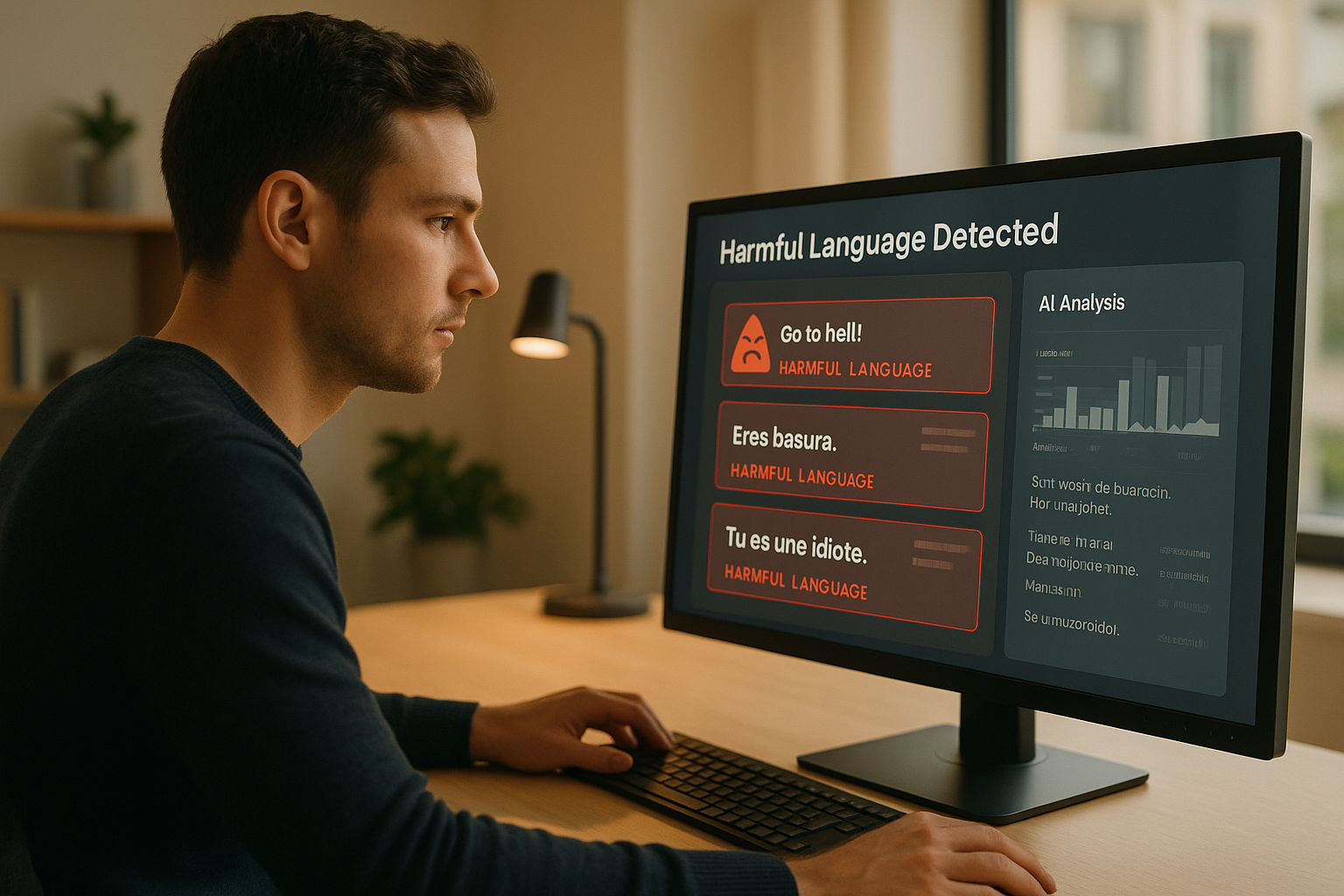
How AI Detects Online Harassment
Online harassment is a growing problem. From cyberbullying to sextortion, harmful behavior online has surged - grooming cases alone have increased 400% since 2020. Traditional moderation methods can’t keep up, leaving victims exposed and platforms overwhelmed.
AI offers a faster, smarter solution. It analyzes context, intent, and patterns in real time, identifying harmful content with up to 92% accuracy. Beyond text, AI scans images, videos, and audio for threats. It works across 40+ languages, tracks repeat offenders, and creates detailed evidence packs for legal teams.
Key highlights:
- Real-time detection: Flags harmful content instantly, prioritizing severe cases.
- Multilingual moderation: Handles harassment in Hindi, Tamil, Urdu, and more.
- Evidence packs: Includes timestamps, metadata, and conversation context for safety teams.
- DM protection: Quarantines harmful messages while preserving fan engagement.
AI isn’t perfect - it still requires human oversight for nuanced decisions. But together, AI and human moderators are reshaping how we protect people online, making digital spaces safer for athletes, creators, and everyday users.
AI vs Cyberbullying: How Technology Detects and Fights Online Abuse
How AI Detects Online Harassment: Core Mechanisms
AI systems use several advanced methods to identify harmful content, going far beyond simple keyword filters. These mechanisms help modern AI spot harassment that might otherwise go unnoticed.
Natural Language Processing (NLP) for Context Analysis
At the heart of AI's ability to understand human language is Natural Language Processing (NLP). This technology examines messages by breaking down word choices, sentence structures, and relationships between phrases to separate harmful language from casual conversations[2][3].
What makes NLP especially powerful is its grasp of context. A phrase that might seem harmless in one scenario could be deeply offensive in another. NLP evaluates the overall sentiment, the history of interactions, and even the relationship between the people communicating to make these distinctions[3].
Advanced NLP systems use word embeddings to understand how words relate to each other. For instance, terms like "stupid", "dumb", and "idiot" are linked in meaning, allowing the system to recognize patterns of harmful language even if some words weren’t explicitly included in its training data. Word embeddings also help detect more subtle behaviors like manipulation or blame-shifting, which are often part of more sophisticated harassment tactics[2][3].
Another key feature is sentiment analysis. By analyzing emotional tone, NLP can flag messages with aggressive or dismissive undertones, even when they don’t contain outright insults. This makes it particularly effective at identifying passive-aggressive comments or subtle jabs that human moderators might miss[3].
Once NLP extracts meaning and context, machine learning models step in to classify the content.
Machine Learning Models for Content Classification
After NLP processes the text, machine learning models determine whether the content is harmful or safe. These models are trained on large datasets containing examples of both harassing and benign messages[2].
Different techniques are used for this classification. Traditional algorithms like Naïve Bayes, Random Forest, and XGBoost are common, while more advanced methods rely on deep learning models such as LSTM (Long Short-Term Memory), BLSTM (Bidirectional LSTM), and CNN (Convolutional Neural Networks)[2]. While deep learning models excel at identifying complex patterns, traditional algorithms often provide faster results and are easier for moderation teams to interpret.
These models are highly accurate, enabling quick responses in real-time scenarios. For instance, one industry-developed detection model achieved 92% accuracy in identifying text designed to embarrass, humiliate, or demean others. It even included a feature to suggest alternative, less harmful phrasing[4].
Techniques like TF-IDF and n-grams enhance the models by identifying key words and phrases that indicate harassment. Additionally, pattern recognition tools track repeated behaviors - such as guilt-tripping or blame-shifting - across multiple interactions[3]. This approach is particularly effective for spotting subtle, long-term harassment that might not be obvious in a single message.
But harassment isn’t limited to just text. AI systems are now tackling harmful content across various formats.
Detection Across Text, Images, and Video
Online harassment has expanded beyond words. Offensive memes, manipulated images, threatening videos, and aggressive audio messages are all tools used by abusers. To address this, AI has evolved to process multimodal content, handling text, images, and audio simultaneously[2].
For audio, AI combines NLP with voice analysis to detect tone, speech patterns, and emotional cues that may not be apparent in written text. It can pick up on vocal signals like raised volume or a sharp, aggressive tone that reveal harmful intent[3].
When it comes to visual content, computer vision enables AI to scan images and videos for offensive memes, altered photos, or threatening gestures[2]. This is especially important in spaces where text and visuals overlap, like social media platforms.
Real-Time Moderation and Multilingual Detection
Stopping harmful content in its tracks is all about speed. The faster harmful material is flagged and removed, the less damage it can cause. AI systems excel here, working 24/7 to identify threats as they emerge and handling content in multiple languages at the same time. Let’s dive into how AI uses real-time alerts and priority systems to tackle threats and how multilingual tools expand protection to audiences worldwide.
Real-Time Alerts and Priority Queues
AI moderation systems don’t waste time. They constantly monitor content, scanning for harmful material and flagging it as soon as it appears. This quick action helps prevent situations from escalating.
When harmful content is detected, the system uses tiered priority queues to sort incidents based on their severity. The most dangerous cases - like direct threats, explicit harassment, or signs of coordinated attacks - are sent straight to moderation teams for immediate attention. Meanwhile, less critical issues, such as borderline insults, are placed in a quarantine queue for further human review.
Some AI systems boast impressive stats, with real-time detection accuracy reaching 77% and classification accuracy for humiliating text going up to 92% [2][4]. These systems also offer explainable AI features, giving moderators clear insights into what triggered a flag - whether it’s specific phrases or contextual details. Automated tools track key metrics like detection accuracy, false positives/negatives, and resolution times, helping organizations improve their processes and even identify repeat offenders.
Multilingual Detection for Global Audiences
AI’s job doesn’t stop at speed - it also needs to understand content in any language to provide thorough protection. Harassment knows no language boundaries. Whether it’s targeting international athletes, global creators, or influencers with diverse audiences, harmful content can crop up in multiple languages at once. Some platforms now moderate content in over 40 languages [2].
As discussed earlier, understanding context is crucial, even across languages. Multilingual AI systems rely on natural language processing (NLP) and machine learning to analyze linguistic nuances. They use tools like semantic analysis, sentiment detection, and pattern recognition to spot manipulative behavior in different languages [3]. For example, these systems can detect cyberbullying in Hindi, Tamil, and Urdu all at once without sacrificing accuracy.
Cultural differences add another layer of complexity. A phrase that’s harmless in one culture might be offensive in another. To address this, multilingual models are trained on diverse datasets to recognize context-specific harassment. These systems also adapt to new harassment tactics as they emerge.
Take platforms like Guardii, which operates in over 40 languages. Its AI can automatically hide toxic comments, flag threats in direct messages, and detect sexualized harassment - no matter the language. Priority and quarantine queues function seamlessly across all languages, ensuring a threat in Urdu gets the same swift response as one in English.
To support safety, legal, and compliance teams, these systems generate detailed evidence packs. These include the original content in its native language, translations, and contextual information. Human moderators, especially native speakers, then review flagged material to catch subtle cultural nuances, fine-tuning the system over time. Together, fast AI detection and informed human oversight create a powerful shield against online harassment.
Evidence and Audit Trails for Safety and Legal Teams
When harassment occurs online, identifying the issue is just the first step. To take meaningful action - whether it’s pursuing legal charges, supporting victims, or meeting regulatory requirements - safety officers, legal teams, and law enforcement need solid documentation. Modern AI systems are designed to create detailed records of harassment incidents, enabling accountability for offenders and reducing liability risks for organizations.
Creating Evidence Packs and Audit Logs
AI-powered moderation tools automatically compile evidence packs whenever harmful content is flagged. These packs include:
- Timestamped screenshots of the offending content.
- Metadata about the user (e.g., username, account creation date, and posting history).
- The full conversation context, so the situation is clear.
- Sentiment analysis to gauge emotional tone and intent.
- The AI's confidence score, showing how certain it is that policies were violated.
Timestamps follow U.S. standards (MM/DD/YYYY HH:MM:SS) to ensure legal clarity. This level of detail helps legal teams evaluate the strength of a case and provides transparency.
In addition to evidence packs, audit logs serve as a secure, permanent record of every moderation action. These logs document who accessed the evidence, when it was reviewed, and what steps were taken. This chain of custody is vital for admissibility in court.
For organizations, this documentation supports internal investigations and legal processes. It also demonstrates to sponsors and partners that the platform actively works to maintain a safe environment. Audit logs can detail when content was flagged, how quickly moderators responded, and what actions were taken - whether hiding a comment, suspending an account, or escalating the issue to law enforcement.
Platforms like Guardii specialize in creating evidence packs and audit logs tailored for safety and legal teams. Guardii’s system tracks threats and harassment in over 40 languages, documenting original messages, translations, and context. By automating data collection, it reduces the need for manual intervention and streamlines both internal and legal responses.
This thorough documentation also helps organizations comply with regulations like the Children's Online Privacy Protection Act (COPPA) and state-level harassment laws. By maintaining systematic records of moderation actions - including AI confidence levels and human review outcomes - organizations can demonstrate they’re adhering to legal requirements[2][3].
AI systems go beyond single incidents, tracking behavior over time to prevent repeat offenses.
Repeat-Offender Watchlists and Documentation
AI doesn’t just focus on individual events - it also monitors patterns to identify repeat offenders. Some users may target multiple victims or return after being flagged. By analyzing behavior across incidents, AI systems track users who are repeatedly flagged for harassment[2].
Repeat-offender watchlists allow for proactive intervention. When someone on the watchlist posts new content, it’s flagged for priority review, potentially stopping further harm. These watchlists rely on account identifiers, IP addresses, device fingerprints, and behavioral patterns, making it easier to detect banned users trying to rejoin or coordinated harassment campaigns[3].
AI can also spot coordinated attacks. For instance, if multiple accounts post similar harmful messages within a short period or target the same individual, the system identifies the pattern. Evidence might include network diagrams, timelines, or linguistic comparisons that reveal the coordinated nature of the harassment[2][3].
Research shows that only 10–20% of online harassment cases are reported to authorities, and even fewer - just 12% - result in prosecution[1]. Often, significant harm has already occurred by the time law enforcement gets involved.
AI systems like Guardii address this gap by automatically quarantining suspicious content. Harmful messages are removed from public view but securely preserved for review by parents or law enforcement[1]. This ensures that even if offenders delete their messages or accounts, the evidence remains intact. Detailed alerts provide context on why the content was flagged, enriching the audit trail.
For victims seeking restraining orders or pursuing criminal charges, evidence packs offer the documentation needed to build a strong case. These records show the full extent of harassment over time, helping victims and their legal teams demonstrate the severity and persistence of the abuse. Organizations can also share redacted versions of these records to protect sensitive information while maintaining their evidentiary value[3].
sbb-itb-47c24b3
AI in Action: Use Cases for Online Safety
AI-powered moderation isn’t just a futuristic concept - it’s actively shielding athletes, influencers, and organizations from online harassment every single day. From managing direct message (DM) threats to protecting sponsor reputations during major events, this technology addresses the unique challenges faced by high-profile individuals and brands.
Protecting Athletes and Creators from DM Harassment
Direct messages have become a hotbed for online threats. Shockingly, 80% of online predation cases start on social media and then move to private DMs[1]. For athletes and creators, this shift creates a dangerous blind spot. Harassment often escalates behind closed doors, going unnoticed until it’s too late.
AI steps in to tackle this issue by screening every incoming message in real time. It doesn’t just look for keywords - it analyzes the overall meaning, emotional tone, and context of a message to determine whether it’s harmful. Advanced models are now 92% accurate in flagging harmful content[2].
Here’s how it works: harmful messages are instantly quarantined, sparing athletes and creators from ever seeing them. These flagged messages are documented and held for review by safety teams. This real-time intervention is critical, especially as online grooming cases have surged over 400% since 2020, while sextortion cases have risen more than 250% during the same period[1].
AI systems also excel at separating harmless fan messages from genuine threats. For example, a comment like “You killed it out there” is recognized as enthusiasm, while explicit imagery or predatory language is flagged as harmful. When concerning content surfaces, it’s preserved as evidence but kept out of the recipient’s inbox.
A platform like Guardii specializes in this type of protection, covering over 40 languages and automatically quarantining harmful DMs. It also sends instant alerts to safety teams via tools like Slack, Microsoft Teams, or email. For athletes and influencers managing thousands of DMs daily, this automation isn’t just helpful - it’s essential.
Beyond protecting individuals, AI also plays a key role in safeguarding brand reputation.
Maintaining Sponsor-Safe Social Media Engagement
Sponsorship deals are big business, with brands investing millions to associate themselves with athletes and teams. But when toxic comments flood an athlete’s post or a team’s announcement, it’s not just reputations at risk - sponsors can also face negative associations that hurt the value of their partnerships.
AI moderation ensures that toxic comments are hidden before they can do damage. This is especially critical during high-stakes events like championships or international competitions, where comment volumes can skyrocket. Without AI, human moderators simply wouldn’t be able to keep up, leaving harmful content visible for too long.
By auto-hiding toxic comments and preserving them in audit logs, AI helps protect sponsorship value while ensuring compliance with platform policies. This approach creates a safer, more positive online environment that sponsors expect.
For organizations managing multiple athletes or teams, AI creates consistency across all accounts. A single toxic comment on one profile can tarnish the reputation of an entire organization. Automated moderation not only prevents this but also demonstrates a proactive commitment to maintaining safe and engaging spaces for fans and sponsors alike.
The challenge is finding the right balance - allowing passionate fan engagement while filtering out harmful content. AI makes this possible by permitting spirited debates and rivalry banter while blocking abusive language. This moderation can even adapt to specific events.
Customizing Moderation Policies for Events and Tours
AI doesn’t just detect harmful content - it can also adapt its moderation policies based on the context of an event. A regular-season game, for example, generates different types of comments than a championship final or a heated rivalry match. With AI, organizations can fine-tune their policies to match the specific risks of each event.
During rivalry games, for instance, temporary allow-lists can be created to distinguish playful banter from targeted harassment. This ensures that the AI doesn’t over-moderate while still filtering out threats, slurs, or explicit content.
For multi-event tours or international competitions, moderation policies can be updated in advance to account for unique risks tied to the location, audience, or opponents. While baseline safety standards - like zero tolerance for threats or hate speech - remain constant, detection parameters can flex to account for cultural or contextual differences.
Organizations can also prioritize high-risk events by setting up special queues for severe threats. On-call moderators can make real-time adjustments during periods of heightened activity, ensuring that the most urgent issues are addressed first. Comprehensive audit trails document which policies were active during each event, offering transparency for sponsors and legal teams.
Guardii supports this level of customization with its Priority and Quarantine queue system. It allows organizations to adjust sensitivity settings, manage rivalry slang allow-lists, and ramp up monitoring during high-risk periods - all while maintaining a consistent safety standard. This adaptability ensures both individuals and brands stay protected, no matter the event.
Balancing Automation with Accuracy: AI Limitations
AI moderation, while powerful, is far from flawless. Even the most advanced systems can stumble, particularly when it comes to understanding nuance. Sure, AI can sift through millions of messages in mere seconds, but it often struggles with context and the crafty ways harassers adapt to evade detection.
The core issue boils down to two types of mistakes: false positives (flagging harmless content as harmful) and false negatives (missing actual abusive content). False positives can disrupt genuine conversations, while false negatives leave people vulnerable to ongoing abuse. Striking the right balance here requires constant fine-tuning and human oversight.
Reducing False Positives and Negatives
AI's strengths shine in its ability to process vast amounts of data, but its limitations become clear when you look at the numbers. Leading models boast an accuracy rate of 92%[2], which sounds impressive - until you consider the remaining 8% error rate. In a high-traffic scenario, like an athlete receiving thousands of messages daily, that margin translates to dozens or even hundreds of misclassified messages.
False positives often arise from AI's inability to grasp context. Sarcasm, for instance, is a classic stumbling block. What might be lighthearted teasing between friends could easily be flagged as harassment when stripped of its context[3]. Regional slang and cultural nuances only add to the complexity - what’s playful in one setting might come across as hostile in another. Without a deeper understanding of these subtleties, AI risks over-policing content that users themselves might not find offensive.
To tackle this, AI systems rely on advanced calibration methods. Techniques like feature extraction and adaptive learning help refine the distinction between harmful and harmless messages[2]. Detection thresholds are also adjusted based on the audience: lower thresholds might be better for high-profile individuals like athletes and public figures, while higher thresholds are more suitable for general users[2].
Guardii takes this a step further with its "smart filtering" approach, focusing on context rather than just scanning for problematic keywords. By analyzing the semantic meaning and emotional tone of messages, the system flags only genuinely concerning content. This reduces unnecessary alerts and fosters user trust. Still, even the most advanced systems can’t catch everything.
The Role of Human Moderators in AI Workflows
This is where human moderators step in. They play a crucial role in handling the gray areas that AI struggles to interpret. In a collaborative workflow, AI performs the heavy lifting by screening large volumes of content, while human moderators review flagged messages to assess context and nuance.
Take a heated sports rivalry, for example. AI might flag aggressive language as abusive, but a human moderator can determine whether it’s just passionate fan debate or something more malicious. This judgment is essential to maintaining a space that encourages lively engagement while ensuring safety.
Human moderators also help improve AI systems through feedback. When they overturn false positives or identify false negatives, that data is fed back to the AI, gradually refining its algorithms. Tools like explainable dashboards provide transparency by highlighting the specific features that triggered a flag - such as repeated blame-shifting, explicit threats, or patterns of sexualized harassment[2]. This feedback loop speeds up decision-making and reduces the need for exhaustive manual reviews.
For communities with athletes, creators, and journalists, human oversight is especially critical in identifying subtle forms of abuse. Behaviors like gaslighting - manipulative tactics involving guilt-tripping or blame-shifting - often require an understanding of broader interaction patterns and relationship histories[3]. While AI can spot certain markers, human insight is essential for determining whether behavior crosses the line into abuse.
Guardii incorporates human review by quarantining flagged messages for further examination. Suspicious content is temporarily hidden from the recipient but remains accessible to safety teams for verification. This ensures immediate protection while allowing for a second layer of judgment.
Human moderators are also instrumental in recognizing new harassment tactics that AI hasn’t yet been trained to detect. As harassers evolve their methods, human expertise helps prompt timely updates to the system. This partnership between AI and human judgment creates a dynamic, adaptive approach to online safety.
Real-time alert systems add another layer of security. Platforms like Guardii notify moderators instantly when severe threats are identified, sending alerts through tools like Slack, Microsoft Teams, or email. This ensures that on-call moderators can act quickly during critical moments. Priority queues help teams focus on the most urgent cases, while detailed audit logs keep track of every decision for legal and safety reviews.
Conclusion
AI has reshaped the way we safeguard people online. Tasks that once required countless human moderators now happen in milliseconds. Advanced systems can analyze text, images, and videos in over 40 languages, identifying everything from blatant threats to subtle manipulation tactics like gaslighting.
With an impressive 92% accuracy rate [2][4], these AI systems process millions of messages daily. They flag toxic comments, threats, and sexual harassment before they reach their intended targets. Real-time alerts allow safety teams to act on serious threats within minutes instead of hours. Priority systems ensure that the most dangerous content - such as direct threats, predatory behavior, or coordinated attacks - gets immediate attention. These tools scale effortlessly to handle high volumes of interactions and adapt to multilingual challenges. Plus, adaptive algorithms evolve continuously to counter new evasion tactics, keeping detection sharp and relevant.
The benefits extend beyond individual protection. AI also provides legal and reputational safeguards. Timestamped evidence packs and audit logs document incidents thoroughly, giving legal teams the tools they need to act effectively. This transparency reassures sponsors and stakeholders that safety is a priority. By turning moderation into a proactive, strategic process, platforms can protect both users and their own reputations.
That said, AI alone isn’t enough. Even the most advanced systems need human oversight for context-sensitive decisions and to address new forms of harassment. The most effective strategy combines AI’s speed and precision with human judgment for complex situations. Platforms like Guardii illustrate this hybrid approach, leveraging AI for initial detection while involving safety teams for verification and escalation.
As online harassment continues to evolve, so must the systems designed to combat it. Moving from reactive moderation to proactive protection isn’t just a technological upgrade - it’s a complete rethinking of what it means to create safe online spaces. By detecting harmful behavior early, AI helps build trust, protect mental well-being, and encourage open, fearless interaction. This is the potential of AI in online safety: fast, intelligent, and flexible enough to make a real impact.
FAQs
How does AI tell the difference between harmful content and friendly banter in diverse languages and cultures?
AI leverages sophisticated algorithms to assess the context, tone, and intent of messages, allowing it to differentiate between harmful content and casual, harmless exchanges. By factoring in elements like slang, regional expressions, and language-specific nuances, it can operate effectively across diverse, multilingual settings.
For example, AI tools are capable of identifying toxic comments, threats, or inappropriate language in direct messages, while ensuring that lighthearted jokes or casual conversations aren't mistakenly flagged. This careful balance helps create a safer and more respectful online environment without stifling authentic interactions.
What challenges does AI face in detecting online harassment, and how can human involvement improve its accuracy?
AI tools, like those utilized by Guardii, excel at spotting and managing harmful content, including toxic comments and threatening messages. They work quickly and efficiently, but they’re not without limitations. For instance, AI can struggle with understanding subtle language cues, sarcasm, or the context behind certain phrases. This can lead to occasional errors, like flagging harmless content or overlooking harmful messages.
That’s where human oversight steps in. Human moderators are essential for reviewing flagged content and fine-tuning the AI’s algorithms. They handle the tricky, nuanced cases that AI might misinterpret, ensuring moderation stays in line with community standards. This teamwork between humans and AI creates safer and more balanced online spaces.
How does AI detect and manage harassment in images or videos?
AI employs cutting-edge technologies like computer vision and machine learning to spot harmful content in images and videos. These systems examine visual elements to detect offensive material, including explicit imagery, violent scenes, or harmful symbols. By analyzing patterns and context, AI can flag or block inappropriate content before it reaches its audience.
For instance, platforms using AI moderation tools can scan multimedia messages, identify potential threats or instances of harassment, and take necessary steps, such as notifying safety teams or concealing the content. This approach helps create a safer online space for users while respecting privacy and adhering to platform policies.