

How AI Improves Age Verification Compliance
If your team still relies on manual moderation, screenshots, and inbox triage, you’re slow where it matters most. I’d fix three things first: hide abusive comments fast, pull DM threat evidence in under 15 minutes, and cut false positives in multilingual slang before match day.
Here’s the short version:
- Instagram comment handling: I’d use auto-hide first, not delete by default, to lower public harm while keeping review options open. That helps with engagement review, sponsor checks, and evidence handling.
- DM threat response: I’d set a workflow that goes from detection → triage → evidence pack → escalation in 15 minutes or less for threats, stalking, extortion, or sexual abuse.
- Tour-language tuning: I’d build allow-lists for rivalry slang and local terms in Hindi, Urdu, Tamil, and Arabic so fan banter doesn’t get treated like abuse.
- Women athletes and creators: I’d use a separate path for sexualized harassment, image-based abuse, and cyberflashing, with tighter evidence rules and faster legal review.
- Sponsor-safe match days: I’d tighten moderation before kick-off so brand posts, collabs, and activations don’t sit next to hate, threats, or explicit abuse.
- Evidence and audit: I’d store comment/DM records with timestamps, handle history, action logs, reviewer notes, and export files so legal and comms teams can act fast.
- Meta-safe moderation: I’d make sure every hide, unhide, restrict, block, report, and delete action follows platform rules and internal policy.
- 40+ language routing: I’d route by language, risk, and account type so high-risk queues get human review and low-risk items get rule-based handling.
- Repeat offenders: I’d track bad actors across 30+ handles using linked watchlists, alias patterns, and case IDs.
- Wellbeing: I’d cut exposure minutes for players and creators without shutting down normal fan conversation.
- Measurement: I’d track precision, recall, review time, false positives, false negatives, and action SLA in a weekly dashboard.
- Creator DMs: I’d protect inbound messages while keeping brand deals, press, and partner outreach visible.
- Legal paths: I’d separate defamation, threats, harassment, impersonation, and sexual abuse because each one needs a different reporting and evidence path.
- Tools: Comment-only tools help, but a setup that covers comments + DMs + evidence exports closes more of the gap.
- Data handling: I’d keep only what safety and legal teams need, with clear retention windows and region rules.
- Tour readiness: I’d tune policies before each fixture or tour and run a weekend on-call plan for spikes.
- Migration: I’d move clubs and agencies off spreadsheets, screenshots, and email chains into one queue with clear owners.
- Quarterly reporting: I’d use a benchmark template to show abuse volume, repeat attackers, response time, and sponsor risk trends.
PEPR '26 - User (Non-)Compliance with Age Verification: Evidence from a Deceptive Web Experiment

sbb-itb-47c24b3
Quick comparison
| Area | Basic setup | Strong setup |
|---|---|---|
| Comments | Manual delete/reply | Auto-hide, review queue, evidence log |
| DMs | Checked ad hoc | Threat routing, priority queues, 15-minute evidence packs |
| Languages | English-only rules | 40+ language routing with local allow-lists |
| Repeat offenders | One-off blocks | Cross-handle watchlists and linked cases |
| Sponsor safety | Manual checks | Match-day brand-safe filtering and escalation |
| Legal support | Screenshots in folders | Chain-of-custody records and export templates |
| Reporting | Volume only | Precision/recall, SLA, exposure minutes, trend review |
If I were building a playbook for a club, league, agent, or creator team today, I’d focus on speed, proof, and low reviewer exposure. That’s what keeps accounts usable, helps sponsors stay comfortable, and gives legal teams records they can use.
Map Legal Requirements to AI System Controls
Map each legal duty to a control you can test, log, and defend. Laws like BIPA, Texas's CUBI/HB 1181, Washington's MHMDA, and California AB 1394 use different wording, but they all push you toward the same blunt question: what does your system do, and can you prove it? [5]
Build a Requirements Matrix by Law, User Age, and Risk Level
Start with a requirements matrix. Each row should track one legal duty. Each column should answer the day-to-day questions your team will face: which jurisdiction applies, what age cutoff matters, which product surface is involved, what assurance level is needed, what consent is required, how long data may be stored, and what proof you need to keep.
In the U.S., age-verification rules often stack on top of each other. BIPA, for instance, calls for written notice, retention limits, and a written release for biometric data. Texas HB 1181, by contrast, requires verification and then immediate deletion of identity data.
The IEEE 2089.1-2024 standard gives teams a practical way to match assurance levels to risk. It sets out four tiers - Asserted, Standard, Enhanced, and Strict - that line up well with product risk levels [5]:
| IEEE 2089.1 Tier | Typical Method | Data Retained | Risk Context |
|---|---|---|---|
| Asserted | Self-declaration | Boolean (Over/Under) | Low-risk content; first-layer defense |
| Standard | Social Graph / Behavioral Inference | Behavioral signals | Medium-risk features; soft gating |
| Enhanced | Facial Age Estimation | Age estimate score | Medium-high risk; age-gating |
| Strict | ID Document + Biometric Liveness | Verification token (ID deleted) | High-risk services like gambling or adult content |
Once that mapping is done, you can assign the right verification workflow to each risk tier instead of guessing case by case.
Turn Regulatory Principles into Testable Controls
Next, turn each principle into a named control with a clear owner and a test. That step matters. A phrase like "data minimization" sounds fine in a policy doc, but it doesn’t mean much until engineering sets a database trigger that deletes ID images the moment an age-over token is issued.
Use buffer thresholds when the law hinges on an exact age. Then document the false-positive rate and tie the threshold to the legal cutoff. That threshold, along with the reason for it, should live in your audit records.
Here’s how common regulatory principles map to concrete controls and tests:
| Requirement | Technical/Operational Control | Testability Method | Owner |
|---|---|---|---|
| Purpose Limitation | Segregated storage; no marketing access to age data | Database schema audit; access log review | Legal / Privacy |
| Data Minimization | Attribute-only assertions (e.g., is_over_18=true) |
Code review of API response payloads | Engineering |
| Retention Limits | Automated purging with TTL triggers | Deletion logs; third-party audit certificates | DevOps |
| Accuracy | Buffer math + NIST FATE benchmark testing | FPR/FNR reports by demographic group | Data Science / AI |
| Transparency | Plain-language notices in user flow | Version-controlled UI screenshots | Product / UX |
| Appeal / Review | Human-in-the-loop escalation for low-confidence cases | SLA tracking for manual review triggers | Trust & Safety |
| Audit Logs | Immutable decision records with method, outcome, timestamp | Third-party audit of signed assertions | Engineering / Legal |
Run disaggregated accuracy tests by race, gender, and skin tone. Then set a remediation threshold in the audit plan before regulators do it for you. [5][8]
Design AI Age Verification Workflows for Accuracy and Scale
AI Age Verification Methods: Accuracy, Friction & Compliance Compared
Once your requirements matrix is in place, the next move is to turn it into a verification workflow that people can get through without friction. It should be fast, accurate, and lean on data collection. In plain English: take the controls on paper and turn them into interoperable routing rules that work in practice.
Choose the Right Verification Method for Each User Journey
Not every user journey needs the same proof level. A social app signup or casual gaming flow doesn't carry the same risk as gambling, adult content, or an age-gated purchase. So the verification method should match the risk.
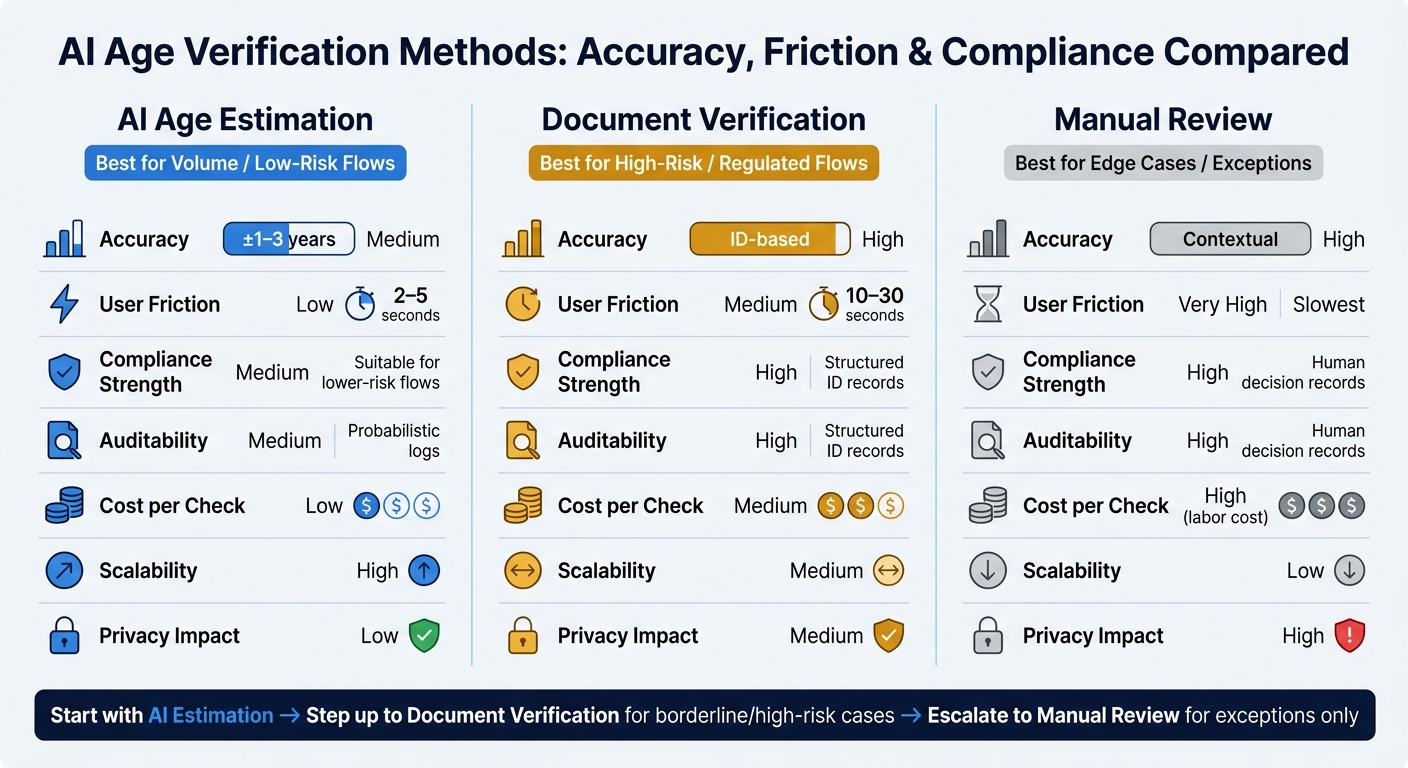
For lower-risk flows, AI facial age estimation works well as a first pass. It's low-friction, usually takes 2–5 seconds, and doesn't require document upload. NIST testing found an average error of 2.5 years in 2024.[4]
For higher-risk flows, document-based verification is usually the better fit. That often means an ID scan plus a liveness selfie. It gives stronger assurance and lines up better with strict compliance needs. The tradeoff is time and cost: it usually takes 10–30 seconds and costs more than AI estimation.[7]
A common setup is simple: start with AI estimation, then move users to document verification when confidence is low or the surface is high-risk.
Set Thresholds, Fallback Rules, and Manual Review Triggers
After you pick the method, define the cutoff for each outcome: auto-pass, step-up, or manual review.
Set an auto-pass buffer above the legal threshold, then send borderline cases to a step-up flow. For an 18+ rule, many teams only auto-pass users estimated at 21 or older. Anyone within three years of the cutoff moves to document verification.[7] That buffer shouldn't live only in someone's head. Write it down, along with why it exists, so your audit trail shows how the decision logic ties back to the legal rule.
Fallback rules matter too. Failed image-quality checks should route to document upload. Unreadable documents with adult-leaning results should go to manual review. The goal is to escalate uncertain cases instead of letting minors slip through or blocking adults by mistake.[1][6]
Manual review should stay limited to edge cases, like suspected spoofing, injection attacks, or situations where automated checks can't make a reliable call.[1][10] And you need to measure how often that happens. Track:
- Share of verifications sent to manual review
- Median verification time
- Completion rate
- False accept and false reject rates by demographic group
That last point matters a lot. Age estimation models can perform unevenly across race, gender, and lighting conditions.[5]
Comparison Table: AI Age Estimation vs. Document Verification vs. Manual Review
Use this table to match proof strength to risk instead of pushing every user through the same path. The goal is to assign the lightest method that still meets the risk level.
| Method | Accuracy | User Friction | Compliance Strength | Auditability | Cost per Check | Scalability | Privacy Impact |
|---|---|---|---|---|---|---|---|
| AI Age Estimation | Medium (±1–3 years) [4][7] | Low (2–5 sec) [7] | Medium - sufficient for lower-risk flows | Medium - probabilistic logs | Low | High | Low |
| Document Verification | High - ID-based | Medium (10–30 sec) [7] | High | High - structured ID records | Medium | Medium | Medium |
| Manual Review | High (contextual) | Very High | High | High - human decision records | High (labor cost) | Low | High |
AI estimation is the volume play. It keeps friction low. Document verification covers high-risk cases and low-confidence results. Manual review is the safety net for exceptions. If you lean on only one method, you'll leave a gap somewhere - in accuracy, scale, or privacy.
Put Privacy-First Controls and Operating Policies in Place
After you route users by risk, the next move is simple: lock down what each verification path keeps.
This is where risk stops being abstract. If raw ID photos or selfie data stick around after a check, you've turned an age-gate into a high-risk identity store. The safer path is to use AI to prove age without building a database full of sensitive identity data.
Apply Data Minimization, Retention Limits, and Secure Storage
Delete raw ID images and selfies as soon as the decision is made. Keep only a pass/fail result or an age-over token. That cuts down the chance of creating data targets that turn into a problem after a breach.[1][11]
Run age estimation in memory, then discard biometric data right away. Don't keep it. Don't turn it into a reusable template.[2]
Access to verification records should stay tight and role-based. Only approved compliance roles should be able to touch identity data. And deletion should happen on a fixed schedule through automated jobs, not manual cleanup that gets skipped or delayed.[1]
Write Notices and Consent Flows That Users and Parents Can Understand
Once you've set retention rules, make sure your notice says what your system actually does.
If you're using an AI age check, the notice should plainly say that the system is estimating an age range, not verifying identity, and that any biometric data used during the check is discarded right after processing.[2]
For users under 13, COPPA applies. You need a verifiable parental consent flow before collecting any data.[11] The FTC issued a policy statement in February 2026 offering enforcement discretion for operators that collect only the personal data needed for age verification, as long as they meet strict security and retention conditions.[12] That carve-out works only if your controls are in place and documented.
Policy-to-Control Table for Audits and Regulator Questions
Use this table as the operating layer for the requirements matrix above. Each row ties a privacy duty tied to post-verification handling to the control that satisfies it.
| Privacy/Compliance Principle | Technical or Organizational Safeguard |
|---|---|
| Raw Data Deletion | Automated deletion of ID images and selfies immediately after the verification decision is rendered |
| Token Storage | Age-over tokens stored in place of full date of birth or raw ID images |
| Parental Consent | Separate verifiable consent flow triggered for users under 13 before any data is collected |
| Access Controls | Role-based access limited to approved compliance roles; no marketing or personalization access |
| Retention Jobs | Scheduled automated purge jobs with deletion logs; 3-year maximum for audit records |
Every row should map to a real control you can test. If you can't point to the exact system, job, or policy that enforces it, then the control isn't there yet.
With storage, consent, and access rules set, the next step is to monitor decision quality and audit the results.
Monitor Performance, Audit Decisions, and Manage Child-Safety Risk
Track the Metrics Regulators and Leadership Will Ask for
Once the system is live, monitoring tells you if your controls still meet the legal bar in day-to-day use. In 2026, regulators want effective age assurance in practice, not just a visible age gate.
That means tracking FAR, FRR, completion rate, average review time, override rate, and deletion SLA compliance. Look at those numbers by verification method and by region, not just in aggregate [1][9].
A low FAR can look good on paper. But it doesn't mean much if the system is blocking a large share of adults. The same goes for rejection patterns across groups. If one demographic is being rejected at a much higher rate, that's a bias signal and it needs a closer look.
Document Evidence, Reviews, and Model Governance
Metrics alone won't cut it. Regulators also expect a trail of evidence that shows how each decision was made.
Your documentation package should include model version history, high-level training data sources, and results from periodic fairness, bias, and drift testing, including confusion matrices. Decision logs should record the method used, the outcome, and the confidence score. Reviewer notes and override reasons should sit with the same decision record. When a policy changes, log that update with a timestamp.
Don't stop at your own systems. Keep vendor evidence too, including deletion audit results, sub-processor mapping, and data retention commitments for every third-party provider in the verification chain [1][9].
The February 2026 Discord breach, which exposed ID images of approximately 70,000 users through a compromised third-party service, is a reminder that your audit trail needs to extend to every partner in the chain [3].
Risk Register Table and Final Implementation Checklist
Use the register to turn repeat compliance problems into actions with a clear owner and review schedule.
| Risk | Likelihood | Impact | Mitigation | Owner | Review Cadence |
|---|---|---|---|---|---|
| Age Misclassification | Medium | High | Confidence thresholds; buffer above legal minimum; manual appeal path | Head of Trust & Safety | Quarterly |
| Demographic Bias | Medium | High | Segment by age, gender, ethnicity; audit training data diversity | Data Science Lead | Twice yearly |
| Data Misuse / Breach | Low | Critical | Data minimization; on-device processing; strict retention SLAs; vendor deletion audits | CISO | Monthly |
| Low Completion Rates | High | Medium | Simplify flow, reduce step-up friction, and route low-risk users to lower-friction methods | Product Manager | Monthly |
| Regulatory Change | High | High | Version-controlled policy map; scheduled legal review | Compliance Officer | Ongoing |
FAQs
When should AI age estimation be used instead of ID checks?
AI-powered facial age estimation works best as a low-friction, privacy-preserving first step for clearing obvious adults without asking for ID. It makes sense when an approximate age threshold, like 18 or 25, is enough and a platform wants to cut user drop-off.
That said, this method is probabilistic. It also gets less accurate as someone gets closer to the age cutoff. So it shouldn't be the final gatekeeper in high-risk cases. In those situations, the safer move is to step up to document-based verification for more certainty.
How can teams reduce bias and false results in AI age verification?
Use a multi-signal approach instead of betting everything on one method. Give users a choice of verification options so the system works better for more people and can balance access, privacy, and accuracy.
For facial estimation, break audit results out by demographic group to spot weak areas that might get hidden in topline numbers. Use threshold-based classification instead of single-point estimates, add a buffer for uncertainty, and send borderline cases to checks with a higher level of assurance. And one more thing: base decisions on independent, audit-ready data, not vendor claims.
What data should be stored after an age check?
Store only the personal information you reasonably need to show compliance.
In many cases, a light check may need little or no storage at all. More detailed identity checks, such as ID scans, may require recordkeeping for up to three years.
If you store biometric identifiers, keep a written retention schedule and a destruction policy. The goal is simple: keep only the proof needed to defend your verification decisions. When possible, store a basic pass-fail result instead of raw identity records.